


Few dive destinations give you as much range in one trip as Hawaiʻi. On the same vacation you can kneel in the sand at night while manta rays somersault through your lights, drop onto a Navy ship off Waikīkī, swim through lava tubes on the Kona coast, and watch a green sea turtle sleep under a ledge. The islands sit in the middle of the Pacific, more than 2,000 miles from the nearest continent, and that isolation shows underwater: roughly a quarter of Hawaiʻi's reef fish species are found nowhere else on Earth.
This guide covers how the main islands compare for scuba diving, the dive sites worth planning a trip around, when to go, the wildlife rules every visiting diver is expected to follow, the altitude issue that catches divers out on the Big Island and Maui, and what to pack.
Which Hawaiian Island Is Best for Scuba Diving?
Each of the four main dive islands has a different personality. Most divers pick one island for a week rather than hopping, because inter-island flights eat into dive time and count as flying after diving.
Big Island (Hawaiʻi Island): Kona Coast
The Kona coast on the island's west side is the strongest all-round choice. It sits in the lee of two massive volcanoes, so the water is usually calm, and the young lava coastline drops off quickly, creating arches, lava tubes, swim-throughs, and pinnacles a short boat ride from Kailua-Kona harbor. Kona is also home to Hawaiʻi's best-known dive, the manta ray night dive (more on that below), and to the "Blackwater" open-ocean night dives that some operators run over deep water for experienced divers.
Maui, Molokini, and Lānaʻi
Maui's headline site is Molokini, a crescent-shaped volcanic crater about three miles off the south shore and a protected Marine Life Conservation District. The inside of the crater is sheltered and suits newer divers, with reef terraces from the shallows down to roughly 60 feet at sites such as Enenue and Middle Reef. The Back Wall on the outside is a different dive entirely: a vertical wall that drops past 300 feet, often swept by current, and best left to experienced divers on a drift profile.
From West Maui, boats also cross the channel to Lānaʻi, where the Cathedrals sites are some of the most photographed dives in the state: lava chambers where sunlight streams through openings in the roof. The crossing makes it a full-day trip, and conditions in the channel decide whether it runs.
Oʻahu: Wrecks and Turtles
Oʻahu is the easiest island to reach and has the best wreck diving in Hawaiʻi. Off the south shore, near Waikīkī, the YO-257 (a former Navy yard oiler sunk in 1989) sits in about 100 feet of water next to the San Pedro, a smaller fishing vessel at roughly 85 feet. The Sea Tiger, an intact 189-foot ship sitting upright in about 120 feet, and the Corsair, a WWII fighter plane in roughly 110 feet, are better suited to divers with Advanced Open Water certification and recent deep experience. On the west side, the Mahi, a former Navy minesweeper in about 85 feet, is a regular stop. In summer, when the North Shore flattens out, Shark's Cove becomes a popular shore dive; in winter, big surf usually makes it undiveable.
Kauaʻi and Niʻihau
Kauaʻi's south shore around Poʻipū has relaxed boat dives, including Sheraton Caverns, a set of lava tubes where green sea turtles rest. The trip many divers come for is offshore: from roughly May through September, when the channel is calmer, a few operators run the crossing of about 17 miles to Niʻihau and Lehua. Expect a long boat ride, deeper profiles (often 60 to 110 feet), current, very clear water, and a real chance of Hawaiian monk seals, gray reef sharks, and pelagics. Operators typically expect advanced certification and recent diving, so check their requirements before you book flights.
The Kona Manta Ray Night Dive
If you only make one "bucket list" dive in Hawaiʻi, most divers will tell you to make it this one. Kona has a resident population of reef manta rays, and after dark they feed on plankton drawn to light. Operators run the dive at two main sites: Garden Eel Cove (also called Manta Heaven) near the airport, and Manta Village near Keauhou Bay. The dive itself is shallow, generally around 30 to 40 feet.
The format is simple. Divers settle on the bottom in a loose circle, sometimes around a central "campfire" of lights, and point their lights up into the water column. Snorkelers float above with lights pointing down. Plankton collects in the beams, and the mantas glide through the light with their mouths open, sometimes passing just inches overhead. Sightings are never guaranteed, but they are frequent, and the dive runs year-round.
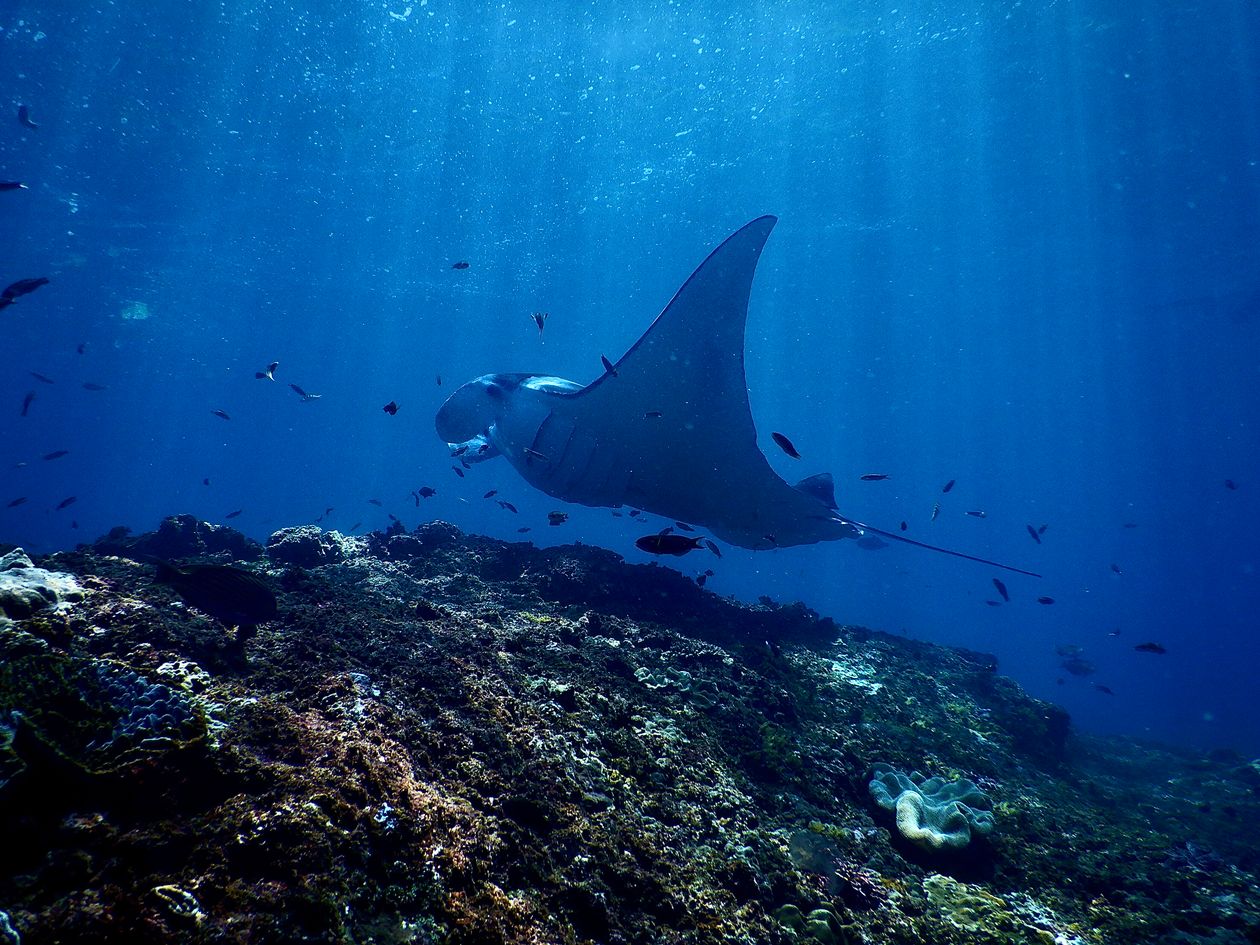
Manta-viewing guidelines adopted by local operators are strict, and crews enforce them:
- Never touch, chase, or grab a manta. Touching removes the protective mucus layer on their skin.
- Stay low and still on the bottom, and keep your hands to yourself or folded on your chest.
- Keep your light pointed up and steady rather than tracking the mantas with it.
- Make sure your buoyancy and weighting are dialed in before the dive so you are not kicking up sand or drifting into the column.
Most operators supply a primary light, but carrying your own compact backup is good practice on any night dive. The SeaLife Sea Dragon Mini 900S is a small, rechargeable light that clips to a BCD D-ring and works well as a backup or a light for checking your gauges. Our guide on how to choose a dive light explains lumens, beam angle, and burn time, or browse all dive lights.

SeaLife Sea Dragon Mini 900S Power Kit
A compact LED light with three output levels from 225 to 900 lumens, a narrow 10.5° beam, strobe and SOS modes, and a 328-foot depth rating. The kit includes a rechargeable 18650 battery, charger, and lanyard, making it an easy-to-pack backup light for night dives.
$119.00 · View product →
For more on manta behavior and the difference between reef and oceanic species, see our guide to diving with manta rays.
When to Dive Hawaiʻi
Hawaiʻi is a year-round dive destination. Ocean temperatures run from about 73°F in late winter (February is usually coolest) to about 82°F in late summer, and leeward shores tend to be a few degrees warmer than windward ones. What changes most through the year is swell direction, which decides which coastlines are diveable.
Summer (May to September)
North-facing shores go flat, which opens up Oʻahu's North Shore and the Niʻihau crossing from Kauaʻi. South shores can pick up summer swell, but the Kona coast and Molokini usually stay diveable. The water is at its warmest, and the manta night dive is particularly popular in these months.
Winter (November to April)
Big north swells close North Shore sites, but south and west-facing coasts remain good. Winter is also humpback whale season. Thousands of humpbacks migrate to Hawaiian waters to mate and give birth, with peak numbers from January through March. You will often hear them singing underwater on your dives, and surface intervals become whale-watching sessions.
Hurricane Season
The Central Pacific hurricane season runs from June 1 to November 30. Direct hits on the islands are rare, but passing storms can raise swell and cancel boats for a few days. Travel insurance that covers trip interruption is worth having.
Wildlife Rules Every Diver in Hawaiʻi Should Know
Hawaiʻi's marine life is protected by both federal and state law, and visiting divers are expected to know the basics. NOAA Fisheries publishes these viewing distances for Hawaiian waters:
- Humpback whales: federal law prohibits approaching within 100 yards, whether by boat, kayak, drone, or while swimming or diving.
- Spinner dolphins: federal law prohibits swimming with, approaching, or remaining within 50 yards of Hawaiian spinner dolphins. This applies within 2 nautical miles of the main Hawaiian Islands and in designated waters, so if a pod shows up on your dive, hold your position and let them pass.
- Hawaiian monk seals: stay at least 50 feet away in the water and on land, and at least 150 feet from a mother with a pup. Monk seals are endangered, and you are most likely to meet one around Kauaʻi and Niʻihau.
- Sea turtles: stay at least 10 feet away. Hawaiian green sea turtles, or honu, often rest under ledges and in caverns, so be careful not to block their path to the surface.
Never touch, chase, or feed any marine life. For help identifying turtles you meet on your dives, see our guide on how to identify sea turtles underwater.
Sunscreen Rules
Since January 1, 2021, Hawaiʻi state law has banned the sale and distribution of over-the-counter sunscreens containing oxybenzone or octinoxate. Maui County, which includes Molokini, Lānaʻi, and Molokaʻi, went further on October 1, 2022, banning the sale, use, and distribution of non-mineral sunscreens unless prescribed. Mineral sunscreens use zinc oxide or titanium dioxide as their active ingredients. The simplest approach anywhere in the islands is to pack a mineral sunscreen and cover up with a long-sleeve rash guard on the boat.
The Altitude Problem: Mauna Kea, Haleakalā, and Saddle Road
This is the Hawaiʻi-specific mistake that catches visiting divers. Some of the most popular non-diving activities on the islands take you to altitudes that matter after diving:
- Saddle Road (Daniel K. Inouye Highway), the main cross-island route between Kona and Hilo, tops out at 6,632 feet.
- The Mauna Kea summit, a popular stargazing trip, is above 13,000 feet.
- Haleakalā, Maui's sunrise drive, reaches 10,023 feet at the summit.
Driving up a mountain after diving reduces the surrounding pressure in the same way a flight does, and it raises your risk of decompression sickness. Treat these trips like flying after diving: plan at least 12 hours after a single no-decompression dive and at least 18 hours after multiple dives or multiple days of diving. The easy solution is to schedule your volcano, summit, and sunrise trips for the start of your vacation or your no-dive day at the end. Our guide to flying after diving covers the guidelines in more detail, and the same planning applies to inter-island flights.
What to Pack for a Hawaiʻi Dive Trip
Wetsuit
A 3mm full suit is the standard choice in Hawaiʻi for most of the year. Even in 80°F water, two or three dives a day, a night manta dive, and wind on the boat ride home will cool you down faster than you expect. In winter, or if you run cold, add a hooded vest or step up to a 5mm. A full suit also protects you from sharp lava rock on shore entries and from stinging hydroids. Our wetsuit buying guide covers thickness and fit.
The Scubapro Everflex Yulex Steamer 3/2mm is a good match for Hawaiian water temperatures, and it comes in short and tall cuts as well as standard sizes. It also comes in a women's version. Browse all wetsuits for other thicknesses.

Scubapro Everflex Yulex Steamer 3/2 mm Men's
A neoprene-free 3/2mm full suit made from plant-based Yulex foam, with a fleece lining, back-zip entry, and stretchy cuffs for easy donning. A warm, flexible choice for divers making several tropical dives a day.
$459.00 · View product →
A BCD You Can Fly With
Hawaiʻi is a flight away for almost everyone, so weight and bulk matter. A lightweight back-inflate BCD packs flatter than a traditional jacket and holds you in a comfortable, horizontal trim on long drifts along the Kona coast or the Molokini Back Wall. The Scubapro Hydros Pro 2 is the best-selling BCD in our store. It has a quick-dry bladder, which helps when you are packing damp gear for a flight home, and a modular design that can be configured for warm-water travel. The Monorail weight pockets release with one hand. Our guide to bringing or renting dive gear can help you decide what is worth carrying, or browse all BCDs.

ScubaPro Hydros Pro 2 BCD with Monorail Weight Pocket Set
A back-inflate BCD with a quick-dry bladder, ergonomic backplate, and Monorail weight pockets (up to 10 lb each) for one-handed operation. Modular parts let you set it up for warm-water travel or colder local diving.
$1,198.00 · View product →
Signaling Gear
Hawaiian boat dives are often run as drifts, and current at sites like the Molokini Back Wall, the Lānaʻi pinnacles, and Niʻihau can carry you away from the group. Carry a surface marker buoy and a whistle or other audible signal on every dive. You will find options in our safety and signaling collection.
Fins and Booties
Shore entries in Hawaiʻi often mean walking over lava rock and through surge. Open-heel fins with hard-soled booties protect your feet far better than full-foot fins. Browse open-heel fins for travel-friendly options.
Dive Computer, Spares, and Insurance
Dive your own dive computer and keep it on your wrist when you fly so it does not get lost in checked baggage. Pack a small save-a-dive kit with a spare mask strap, fin strap, mouthpiece, and O-rings. Dive accident insurance, such as DAN coverage, is worth having on any trip involving deep wrecks or remote sites like Niʻihau. For airline rules, see our guide to flying with scuba gear.
Planning a Week of Diving in Hawaiʻi
Here is how a typical week on the Big Island might run. Spend day one on volcano sightseeing and any high-altitude trips before you dive. Then make a shallow checkout dive on the Kona coast, followed by two days of boat dives exploring the lava tubes and arches. Book the manta night dive once your weighting is sorted. Add a second manta dive or a Blackwater dive if you are experienced. Keep the last day dry before your flight. On Maui, swap in Molokini and a Lānaʻi day; on Oʻahu, build the week around the south shore wrecks and summer North Shore shore dives.
Book the trips that depend most on weather, like the Lānaʻi crossing, the Molokini Back Wall, and Niʻihau, early in the week. That way, a cancelled day can be rescheduled instead of lost.
Frequently Asked Questions
Which Hawaiian island has the best scuba diving?
For most divers, the Big Island's Kona coast is the best all-round choice: calm water, dramatic lava formations, and the manta ray night dive. Maui is best for Molokini and Lānaʻi, Oʻahu for wrecks, and Kauaʻi for the summer-only Niʻihau trips.
What is the best time of year to scuba dive in Hawaiʻi?
Diving is good year-round. Summer brings the warmest water and opens up north shores and Niʻihau. Winter brings humpback whales, which you can often hear underwater, but closes most north-facing sites.
Do I need a wetsuit to dive in Hawaiʻi?
Yes, for most divers. Water temperatures range from about 73°F to 82°F, and a 3mm full suit is the standard choice. Consider adding a vest or using a 5mm in winter or for night dives.
Can beginners do the Kona manta ray night dive?
Yes. The dive is shallow, around 30 to 40 feet, and divers stay settled on the bottom. Operators generally require Open Water certification, and some prefer that you complete a daytime dive with them first. Good buoyancy control matters more than certification level.
How long should I wait after diving to drive up Mauna Kea or Haleakalā?
Use the same guidelines as flying after diving: at least 12 hours after a single no-decompression dive and at least 18 hours after repetitive dives or multiple dive days. Saddle Road on the Big Island also climbs above 6,600 feet, so plan cross-island drives with this in mind.
Plan Your Hawaiʻi Dive Trip
Hawaiʻi rewards divers who pick the right island for the season, respect the wildlife distances, and plan their mountain trips around their dives rather than after them. Pack a 3mm suit, a light for the mantas, an SMB for the drifts, and mineral sunscreen. Then leave room in the schedule for the day the channel lies down and the boat heads somewhere special.


