Get up to 10% cashback
with our rewards program




Technical Gauges — Analog Reliability for Serious Diving
Dive computers do more, but gauges fail differently. A mechanical submersible pressure gauge has no battery to die, no firmware to corrupt, and no screen to go dark at the worst moment — it either reads correctly or it visibly doesn't. That's why technical divers still run analog instrumentation, either as primary in a minimalist configuration or as the redundant backup that keeps a dive viable when electronics quit. In sidemount, stage, and decompression configurations, a compact SPG on a short hose is often the only sensible option regardless of what's on your wrist.
This collection covers both pressure and depth instrumentation built to technical standards — oxygen-clean gauges rated for high-percentage mixes, brass Bourdon tube mechanisms that hold calibration through hard knocks, low-profile modules for streamlined rigs, and digital depth gauges rated well past recreational limits. At DiveCatalog.com, we carry these as an authorized dealer for every brand represented.
The Technical Gauge Range
Submersible Pressure Gauges (SPGs)
The Mares SPG52 is purpose-built for technical diving. Double welding allows it to be used without a protective cover, and the copper Bourdon tube mechanism holds calibration even after significant impact. Available with a 15cm hose for sidemount and stage bottle configurations, or a 56cm hose as the primary instrument in a standard technical setup. Oxygen-clean compatible for high-percentage mixes.
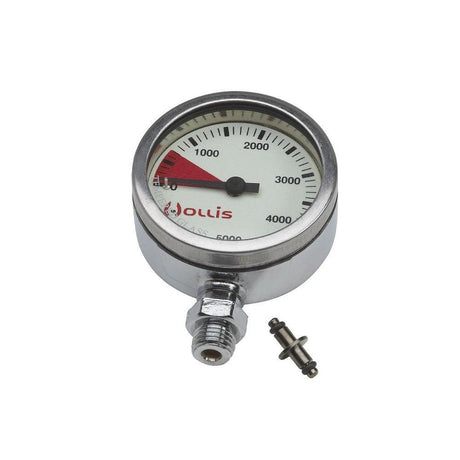
The Hollis Low Profile Pressure Gauge Module targets streamlined rigs — a super-hard PVD-coated brass housing with a Bourdon tube, scratch-resistant lens, high-contrast dial, and luminescent needle. Ships without a boot, includes Air Spool and Viton O-rings, and is oxygen-clean for mixed gas. Reads 0–5000 PSI (0–400 BAR) on a 1.5″ dial. The standard Hollis Pressure Gauge Module uses a 2-inch brass SPG core with a luminescent face plate and chrome-plated brass housing, also rated 0–5000 PSI.
The Zeagle Single Gauge uses a rugged one-piece brass body rated to 5000 psi with a copper beryllium spiral-wound ring and Bourdon tube. Large custom luminescent dial, ergonomic low-profile housing, two integrated attachment points for configuration flexibility, and an 11″ black hose. Operating range of 40°C to −5°C (104°F to 23°F), available in imperial or metric.
The Sherwood 2″ Brass Pressure Gauge is a dual-scale 5000psi/350BAR gauge supplied complete with gauge, boot, and hose — a straightforward, dependable pressure solution.
Pressure Gauge Capsules
Scubapro Pressure Gauge Capsules are the gauge mechanisms themselves, for building or rebuilding console assemblies. Available in Dual Metric/Imperial, Imperial-only (0° orientation, reading to 6000 psi, in a shock-proof boot), and a 40° angled Metric version that matches common console orientations for easier reading without repositioning the console.
Pony and Stage Bottle Gauges
The Hollis Large Pony Compact Bottle Gauge connects directly to the 7/16″ high-pressure port of a pony bottle or alternate tank regulator — a minimal, purpose-sized gauge for monitoring a redundant or stage cylinder without adding a full-size instrument to the rig.
Digital Depth Gauges
The Scubapro Digital 330M Wrist Depth Gauge is rated to 330m (1082 ft), well past technical limits, and displays actual depth, maximum depth, dive time, temperature, and ascent rate. Automatic altitude compensation adjusts when you change dive locations, auto on/off engages after a quick self-test, and a logbook stores the last 20 dives with a surface interval display for planning. Available in Metric and Imperial. Works as a primary bottom timer in gauge-mode diving or as a backup instrument alongside a computer.
Key Technical Gauge Features
- Bourdon tube mechanism: The coiled tube that flexes under pressure to drive the needle. Copper and brass Bourdon tubes hold calibration through impacts that would knock a lesser mechanism out of true — which is why they remain standard in technical gauges.
- Oxygen clean: Gauges cleaned and built with compatible materials for use with high-percentage oxygen mixes. Required for decompression gases and any mix above standard nitrox percentages; using a non-O2-clean gauge with high-O2 mixes is a genuine safety issue.
- Luminescent dials and needles: Charge under ambient or torch light and glow in low visibility — essential in wrecks, caves, night dives, and deep water where color and contrast disappear.
- Low-profile housings: Reduce snag points and drag in overhead environments where a protruding instrument is a genuine entanglement risk.
- Short-hose configurations: 11–15cm hoses keep sidemount and stage cylinder gauges tight to the bottle rather than trailing loose.
- Double welding: On gauges like the Mares SPG52, allows use without a protective rubber boot — less bulk, fewer components, one less thing to trap silt.
Choosing Your Technical Gauge
| Configuration | Recommended Gauge | Key Reason |
|---|---|---|
| Sidemount and stage bottles | Mares SPG52 15cm | Short hose keeps the gauge tight to the cylinder; oxygen clean |
| Primary technical configuration | Mares SPG52 56cm | Double welded for boot-free use; copper Bourdon holds calibration |
| Streamlined rigs in overhead environments | Hollis Low Profile Module | PVD-coated brass, 1.5″ dial, minimal snag profile, O2 clean |
| Pony or redundant cylinder monitoring | Hollis Large Pony Gauge | Connects direct to 7/16″ HP port; minimal added bulk |
| Building or rebuilding a console | Scubapro Gauge Capsules | 0° and 40° orientations; metric, imperial, or dual scale |
| Gauge-mode diving or backup depth reference | Scubapro Digital 330M | 330m rating, ascent rate, altitude compensation, 20-dive log |
Maintenance & Care
- Rinse thoroughly in fresh water after every saltwater dive, paying attention to the hose swivel and spool connection.
- Never disconnect a gauge from a pressurized hose — depressurize the system first.
- Inspect the lens for cracks and the hose for bulges, cuts, or corrosion at the crimp before each dive.
- Check that the needle returns fully to zero when depressurized; a needle that rests off-zero indicates a mechanism that needs service.
- Store away from direct sunlight and avoid coiling hoses tightly, which stresses the crimp over time.
- Have gauges serviced alongside your regulator at manufacturer-recommended intervals.
Why Buy Technical Gauges from DiveCatalog.com?
- Authorized dealer for Scubapro, Hollis, Mares, Sherwood, and Zeagle — genuine products, full manufacturer warranty
- Full configuration range — SPGs, capsules, pony gauges, and digital depth instruments
- Expert advice — our team can help you spec gauges and hose lengths for sidemount, stage, and doubles configurations
- Fast shipping — in-stock items ship within one business day
- Rewards program — earn points on every purchase
Frequently Asked Questions
Why carry an analog gauge if I already have a dive computer?
Redundancy, and a different failure mode. An air-integrated computer depends on a battery, a transmitter, and a wireless link — any of which can fail mid-dive. A mechanical SPG has no battery and no electronics. In technical diving, where a direct ascent may not be available, carrying instrumentation that fails differently from your primary is standard practice rather than an optional extra.
What does “oxygen clean” actually mean?
The gauge has been cleaned of hydrocarbons and built with materials compatible with high-percentage oxygen. Standard lubricants and residues can ignite in an oxygen-rich environment under pressure. If you're diving decompression mixes or anything above standard nitrox percentages, oxygen-clean instrumentation isn't optional.
What hose length should I use?
It depends on configuration. A 56cm hose suits a standard backmount technical setup where the gauge routes under the left arm. Short hoses of 11–15cm are for sidemount and stage bottles, keeping the gauge clipped tight against the cylinder rather than trailing. Running a long hose on a stage bottle creates a genuine entanglement hazard.
What is a Bourdon tube?
The mechanism inside most analog pressure gauges — a curved metal tube that straightens slightly as internal pressure rises, driving the needle through a linkage. Copper and brass Bourdon tubes are valued in technical gauges because they hold calibration through impacts and temperature swings that would disturb less robust mechanisms.
Do I need a boot on my gauge?
Not always. Boots protect the housing and lens from impact, but add bulk and can trap silt and salt against the gauge body. Gauges built with double welding, like the Mares SPG52, are designed to be run without a boot — a cleaner, lower-profile option for technical configurations.
Can I use a depth gauge instead of a dive computer?
For gauge-mode diving, where the diver runs decompression from tables or a pre-planned schedule, a depth gauge and bottom timer is the correct tool — this is standard practice in some technical training. It requires proper training in dive planning and table use, and is not a substitute for a computer in recreational diving.
Browse the full technical gauge collection above, or narrow to Technical Pressure Gauges or Technical Compasses. Reach out if you'd like help speccing instrumentation for your configuration.