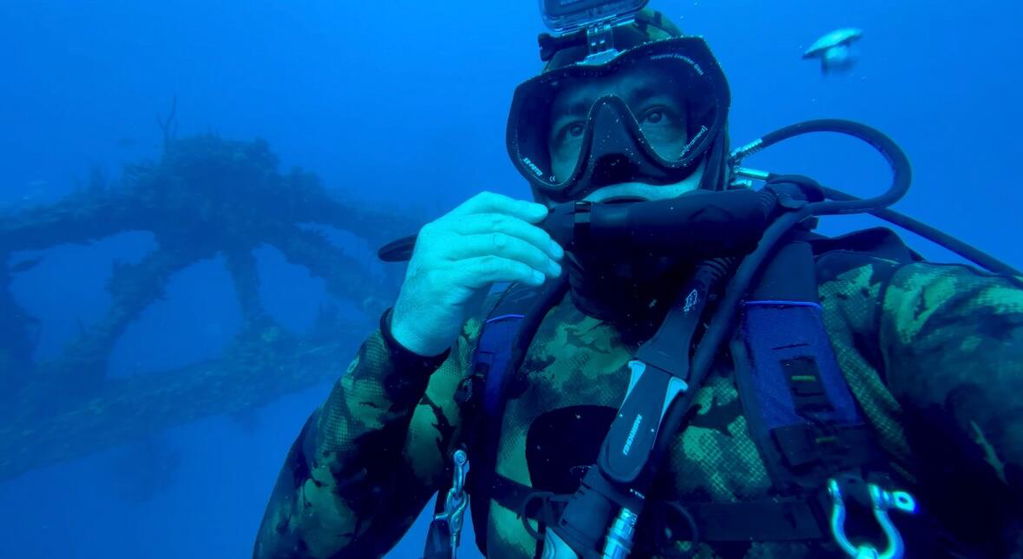
The last morning of a dive trip has a particular ache to it. The boat is loading, the water is flat, and you are sitting on the dock with a coffee because your flight leaves at four. Every diver who has traveled has felt it, and every diver who has traveled has heard a different number for how long you are supposed to wait. Twelve hours. Eighteen. Twenty-four. "Just don't dive the day you fly."
The rules are clearer than the dock chatter suggests. This guide lays out what the current guidelines say, why the wait exists, how to plan a trip around it without losing a full day, and how to handle the reverse question of diving after a long flight.
The short answer: 12 hours, 18 hours, or longer
The most widely accepted guidance comes from Divers Alert Network (DAN), developed at a workshop with the recreational diving industry and refined from a series of Duke University chamber trials. For divers with no symptoms of decompression sickness, the minimum preflight surface intervals are:
- Single no-decompression dive: at least 12 hours before flying.
- Multiple dives in a day, or multiple days of diving: at least 18 hours before flying.
- Dives that required decompression stops: substantially longer than 18 hours. Many technical divers and training agencies treat 24 hours as the practical floor.
These figures apply to flights in pressurized aircraft with cabin altitudes between roughly 2,000 and 8,000 feet (610 to 2,438 meters), which covers essentially all commercial airline travel. They are minimums, not targets. Longer is always safer, and a preflight interval does not reduce your risk of decompression sickness to zero; it reduces it to a level the diving community has agreed is acceptable.
PADI, NAUI, SSI, and most other training agencies teach guidance that aligns with these numbers, so if your open water course told you something similar, that is why.
Why flying after diving is a problem
Every dive loads your tissues with dissolved nitrogen. After you surface, that nitrogen leaves slowly through your lungs over the following hours. Surfacing is itself a pressure drop, which is why ascent rates and safety stops matter, but the pressure drop does not stop at sea level if you then get on a plane.
Commercial aircraft are pressurized, but not to sea level. Regulators allow a cabin altitude of up to 8,000 feet at normal cruise, which is a meaningful reduction in ambient pressure. If you still have excess nitrogen in your tissues when the cabin climbs, the drop can cause bubbles to form or grow in exactly the same way an overly fast ascent would. The result is decompression sickness (DCS) at 35,000 feet, hours from the nearest recompression chamber.
The chamber trials behind the DAN guidelines are instructive. Across 802 simulated flights at 8,000 feet following dive profiles near recreational no-decompression limits, there were 40 cases of DCS. For single dives, none occurred with surface intervals of 11 hours or more. For repetitive dives, cases occurred with intervals under 17 hours. Round up, add a margin, and you have the 12- and 18-hour figures.
One caveat the researchers stressed: those trials used dry, resting volunteers. Real dive trips involve immersion, exercise, cold, and multiple consecutive days of diving, all of which are plausible reasons to wait longer than the minimum rather than cutting it close.
It is not just airplanes: driving to altitude counts too
The physiology does not care whether you gain altitude in a pressurized cabin or a rental car. Driving over a mountain pass after a coastal dive trip is an ascent to altitude and carries similar risk. This catches divers in places like Hawaii, Southern California, parts of Mexico, and the Red Sea, where a road home or a scenic detour can climb well above 2,000 feet.
Treat any post-dive travel above roughly 2,000 feet (610 meters) the same way you would treat a flight: apply the 12- or 18-hour rule, or plan the route to stay low. Local dive operators usually know exactly which roads are a problem; ask them.
How to plan a dive trip around the no-fly window
This is where good trip planning pays for itself. A few habits keep the surface interval from eating a day you paid for.
Book the departure flight first, then work backward
Before committing to a dive schedule, look at your homebound flight time and subtract 18 hours. Whatever time that lands on is your last surfacing time. A 2 p.m. flight means you should be out of the water by 8 p.m. the day before, which is easily done. A 7 a.m. flight means your last dive ends by 1 p.m. two days prior, which quietly removes an afternoon of diving. If you have a choice of flights, a later departure is worth a modest fare difference.
Make the last day a surface day on purpose
Rather than sitting on the dock feeling sorry for yourself, build the final day into the itinerary. Snorkel a shallow reef, take the island tour you skipped, rinse and dry gear properly so it does not travel wet, and sort through photos. Divers who plan the surface day enjoy it. Divers who have it imposed on them do not.
Liveaboards handle this for you, mostly
Nearly every liveaboard schedules its final dive to end at least 18 hours before guests disembark for the airport, and many build in more. Confirm the actual timing before booking a same-day flight home, because "disembark at 8 a.m." does not always mean "last dive ended 18 hours earlier." Our guide to liveaboard versus resort diving covers the scheduling differences in more detail.
Let your dive computer track the countdown
Every modern dive computer calculates and displays a no-fly time after each dive, based on your actual profiles rather than a blanket rule. Many manufacturers are more conservative than the DAN minimums, and some apply a flat 24 hours after any dive series. The rule is simple: follow whichever is longer, the computer or the guideline. Never treat a computer showing zero as permission to ignore an 18-hour minimum you have not yet reached.
If you travel with rental computers, you lose that continuity; a rental returned on day five knows nothing about the dives you did on day six with a different unit. That alone is a good argument for owning your own. The Suunto Zoop Novo is a long-running favorite for travelers who want a reliable, easy-to-read computer with a clear no-fly readout at a modest price. The Garmin Descent G2 adds a full-color display, multi-day logging, and a watch you can wear through the airport. Browse the wrist dive computers collection for other options, and dive whatever you buy at home before it becomes your only reference on a trip.

What to do during the preflight surface interval
The wait is not passive. A few choices during those hours change how well nitrogen leaves your body.
Hydrate. Dehydration is one of the most commonly cited contributing factors in DCS cases, and dive trips are dehydrating by nature: sun, salt, dry compressed air, and often a beer or two. Drink water steadily the day before the flight and during it.
Go easy on alcohol. It dehydrates you and can mask early symptoms. A celebratory drink is fine; a last-night blowout before an early flight is not.
Skip strenuous exercise. Heavy exertion after diving is thought to promote bubble formation. Save the hotel gym for the day you get home.
Avoid hot tubs and very hot showers right after diving. Rapid warming can encourage bubbles to come out of solution. A normal shower is fine; an hour in a 104°F spa immediately after your last dive is not the best idea.
Pay attention to how you feel. Unusual fatigue, joint pain, tingling, numbness, a rash, dizziness, or difficulty thinking clearly in the hours after diving are all possible DCS symptoms. This matters more than any timer: if you have symptoms, do not fly. Flying with untreated DCS reliably makes it worse. Call DAN's emergency line at +1-919-684-9111 (available 24 hours) or local emergency services, and get evaluated before boarding. DAN's own review found that more divers fly with symptoms than develop them in the air, which makes this the single most important sentence in this article.
Diving after flying: the other direction
The question comes up almost as often, and the answer is more relaxed. Flying before diving does not load your tissues with nitrogen, so there is no decompression reason to wait after you land. You can, in principle, step off a plane and onto a dive boat.
In practice, most experienced travelers do not, for reasons that have nothing to do with physiology. A long-haul flight leaves you dehydrated, tired, jet-lagged, and often a little congested from dry cabin air, and that is a poor state in which to equalize, manage a current, or stay sharp on an unfamiliar site. Dehydration in particular raises your DCS risk on the dives you are about to do.
A sensible plan is to arrive, drink water, eat a real meal, sleep a full night, and dive the next morning. If the itinerary forces a same-day dive, keep it shallow and easy, and be honest with the divemaster about how you feel. Airlines also occasionally lose bags, and a rest day gives yours time to catch up; if that worries you, our guide to flying with scuba gear covers what to carry on and what can go in the hold.
A sample itinerary that gets the timing right
For a seven-night trip with a 1 p.m. departure flight on day eight:
- Day 1: Arrive, hydrate, sleep. No diving.
- Days 2 through 6: Two- or three-tank days. Log everything on your own computer.
- Day 7: Final two-tank morning, out of the water by noon. That gives 25 hours before wheels-up, comfortably beyond the 18-hour minimum for multi-day diving.
- Day 7 afternoon: Rinse gear, hang it to dry, pack the mesh bag last so any damp items get airflow.
- Day 8: Fly home symptom-free.
A day-trip mesh backpack makes the rinse-and-dry routine easier because everything drains in the bag. The Tusa 81L Mesh Dive Backpack is large enough for a full recreational kit and folds flat inside a roller for the flight. See the gear backpacks collection for lighter options.

Quick reference
- One no-deco dive: wait at least 12 hours before flying.
- Multiple dives or multiple days: wait at least 18 hours.
- Decompression dives: wait substantially longer, commonly 24 hours or more.
- Driving above about 2,000 feet counts as ascending to altitude.
- Follow your dive computer's no-fly time if it is longer than the guideline.
- Any DCS symptoms mean no flying until you have been evaluated.
- Diving after flying has no decompression restriction; rest and rehydrate anyway.
The wait is a small price for a trip that ends the way it should, with you walking off the plane thinking about the next one. Plan the flights first, give the last day a purpose, and let the reef wait for you.