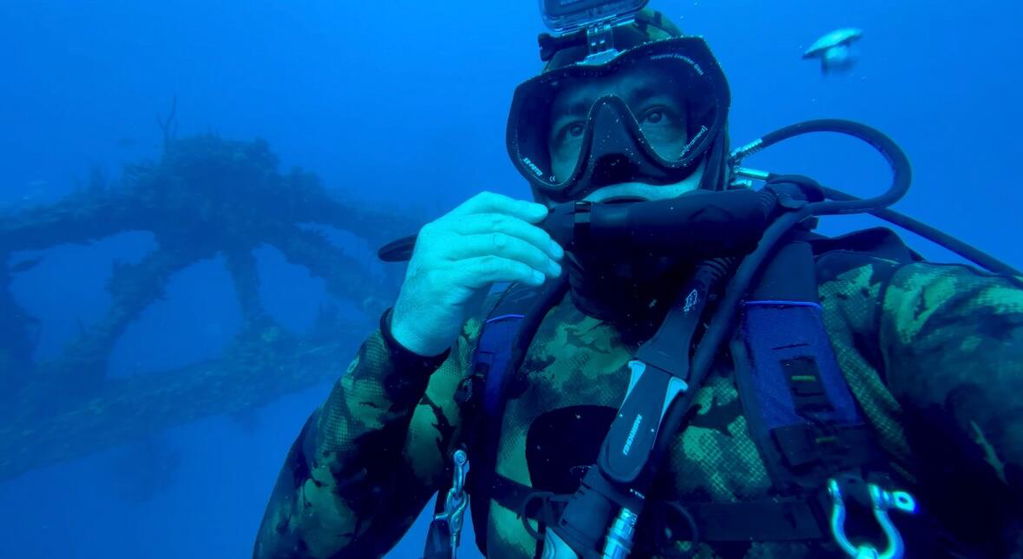
Every club dive has the same moment. You've just been paired with someone you met twenty minutes ago in the parking lot, you're both kitted up, and there's a slightly awkward pause where each of you is waiting for the other to suggest a buddy check. Half the time it gets skipped, or reduced to a thumbs-up and a "you good?" — and that's exactly the situation the pre-dive safety check was designed for.
When you dive with your regular buddy, you already know where their weight pockets release and which way their inflator hose runs. With a new buddy you know none of that, which is why the check matters more, not less. This guide walks through the five-step buddy check — BWRAF, the version most divers learned in their Open Water course — with a focus on doing it well with someone whose gear you've never seen before.
What BWRAF stands for
BWRAF is the acronym PADI uses for the pre-dive safety check: BCD, Weights, Releases, Air, Final check. Other training agencies teach the same content under different names, and you'll hear a dozen mnemonics for it — "Begin With Review And Friend" is the official one, "Bruce Willis Ruins All Films" is the one people actually remember. The order isn't sacred. What matters is that you cover all five areas, on both divers, before you get in the water.
Two things separate a real buddy check from a token one. First, you check each other's gear, not your own — the point is that a second pair of eyes catches what you've stopped noticing. Second, you touch things. Looking at a weight pocket tells you nothing about whether it's seated. Tugging on it does.
Before you start: a thirty-second gear tour
With a new buddy, add one step before the check itself. Ask them to show you their kit — specifically anything you'd need to find in a hurry. This takes half a minute and turns the rest of the check from guesswork into confirmation.
Ask where their alternate air source is and how it's secured. Ask how their weights release — integrated pockets, a belt, trim pockets on the tank band, or some combination. Ask whether there's anything unusual: a long hose, a sidemount rig, a drysuit with a separate inflator, a pony bottle. Then show them yours. Divers who've been at it for years sometimes forget that a newer diver may never have seen a backplate-and-wing or a drysuit up close, and a rescue is not the moment to learn how one works.
The conversation about experience and comfort level belongs here too. A buddy check is the natural moment to agree a maximum depth, a turn pressure, and what you'll do if you get separated.
B — BCD
Have your buddy inflate their BCD fully using the power inflator, then listen. A slow hiss from the inflator button means a sticking valve that could auto-inflate at depth. Check that the BCD holds air for a few seconds without visibly deflating. Then have them dump air using every release they have — the deflate button on the inflator, the shoulder dump, and the rear or lower dump — so you both know where those are and that they work.
Confirm the low-pressure inflator hose is actually connected to the inflator; it's the single most common thing found during a check. Finally, check that the tank band is tight. Lift the cylinder gently by the valve — if it slides in the band, re-cinch it. A tank that drops out of a loose band mid-dive is dangerous and surprisingly common on rental and club gear.
W — Weights
This is the step most likely to be skipped with a new buddy, because touching someone's weight pockets feels intrusive. Do it anyway. Confirm the weights are in place and the pockets or belt are secure, and — critically — make sure you know how to ditch them. Integrated systems vary: some pull straight out, some need a handle rotated first, some have a secondary clip. If you've never used that model, ask your buddy to demonstrate the release motion before the pockets go in.
If your buddy is on a weight belt, check that it's right-hand release and that the free end is tucked so it can't slip through the buckle. If they're carrying trim weights on the tank band, note that those don't ditch — which means the weight in the pockets or belt needs to be enough to get them positively buoyant on its own.
Also check the amount. A newer club member who's just switched from a rental 7 mm to their own 5 mm suit is often carrying two or three kilos more than they need. If they haven't done a weight check recently, suggest one at the surface before the descent — our weighting guide covers how.
R — Releases
Go through every buckle and strap on the BCD: shoulder releases, chest strap, waist strap or cummerbund, and the tank band cam buckle. Confirm they're fastened, not twisted, and that nothing is trapped underneath — a snorkel keeper or a hose caught under a shoulder strap is a classic. Know which way each buckle opens; on a rescue you may need to strip your buddy's kit at the surface, and fumbling with an unfamiliar release while supporting an unconscious diver is not where you want to discover it's a different design from yours.
If either of you is diving a drysuit, treat the neck and wrist seals and the zip as releases too. Check the zip is fully closed — running a finger along it is faster than looking — and the inflator hose is connected.
A — Air
Have your buddy turn their valve fully on, then check the gauge. On a full tank you're looking for roughly 200 bar or 3000 psi; anything meaningfully below that on a "full" cylinder is worth a conversation before you walk to the water. Then watch the gauge while your buddy takes three or four deep breaths from the primary regulator. The needle should stay put. A gauge that drops as they inhale means the valve is only partly open or there's a restriction somewhere.
Now breathe from their alternate yourself. Not a puff — two or three full breaths, so you know it delivers gas cleanly and doesn't free-flow when it's out of your mouth. It's your alternate too, in the sense that it's the one you'll be reaching for. Check that it's clipped where they said it was during the gear tour, in the triangle between chin and ribcage, and that you can pull it free with one hand. A regulator that works perfectly but is tucked into a BCD pocket under a strap isn't an alternate air source. Taste the air while you're at it — any oily or off smell means that cylinder doesn't get dived.
Look at the hoses as well. Cracked hose covers, a first stage that hisses at the yoke or DIN connection, and a mouthpiece with a torn bite tab are all things you'd rather find on land. If your buddy's gear looks tired, that's a kind conversation to have after the dive, and our equipment servicing guide is a good link to send.
F — Final check
Step back and look at your buddy top to bottom. Mask on the forehead or around the neck, snorkel if they carry one, fins in hand, computer switched on and set to the right gas, dive light or camera clipped off, and nothing dangling. Loose gauges and dangling alternates are the leading cause of the reef damage everyone blames on "other divers" — a small retractor or clip fixes it in seconds. Then confirm the dive plan out loud: max depth, planned time, turn pressure, ascent signal, and what to do if separated (the standard answer is search for one minute, then surface).
Gear that makes diving with a new buddy easier
Nothing on this list is mandatory, but each item removes a source of friction when you're diving with someone whose habits you don't yet know.
A surface marker buoy — and agreement on who deploys it
If you and your new buddy get separated and surface apart, an SMB is what turns "somewhere out there" into a visible orange target for the boat. Every diver in the pair should carry one, and the check is the moment to confirm who deploys at the safety stop. The Hollis Orange Marker Buoy with Sling Pouch ($129.95) is a full-size, high-visibility option that stows in its own pouch on a BCD D-ring. The safety and signaling collection covers compact SMBs, reels, and audible signals if you need something smaller.

Hollis Orange Marker Buoy w/ Sling Pouch
Full-size, high-visibility SMB that stows in its own pouch on a BCD D-ring. Easy for either buddy to deploy at the safety stop.
$129.95 · View product →
A slate
Hand signals cover the essentials, but a new buddy won't know your club's unofficial signals for "look at that" or "let's go back toward the wall." A wrist slate settles any underwater disagreement in a few seconds and is useful for writing the dive plan down during the check itself. The Hollis 3-Piece Wrist Slate ($28.95) straps to the forearm and stays out of the way; the Scubapro Multilayerpro Slate ($34.90) is a larger three-page slate that clips to a D-ring. Browse the slates collection for other formats.

Three-page slate that straps to your forearm and stays out of the way. Handy for writing the dive plan down during the check.
$28.95 · View product →
A retractor or clip for your gauges
The "F" step goes faster when there's nothing to tidy. A simple retractor like the DiveCatalog Auto-Rebound Retractor ($39.95, 18-inch) keeps a console or light close to the body and lets you pull it out to read without unclipping anything.
A dive computer each
Sharing a computer between buddies is a bad habit that new pairs sometimes fall into on club dives. Two divers at slightly different depths for forty minutes have different decompression obligations, and if you separate, the diver without a computer has no ascent-rate or safety-stop information at all. If someone in your club is still diving on tables or borrowing, the dive computers collection starts with entry-level wrist units.
Making the buddy check a club habit
If you organize dives, the fastest way to get everyone doing a proper check is to build it into the briefing rather than leaving it to individual pairs. Pair people up before the briefing, not after, so they have time. Announce a "buddy check, then walk to the water" step by name. And model it — when the divemaster or club lead visibly does a full BWRAF with their own buddy, nobody feels self-conscious about doing the same.
It also helps to normalize the awkward part. Tell new members explicitly that they're expected to handle their buddy's weight pockets and breathe from their alternate, and that experienced divers are expected to walk newer ones through unfamiliar gear without being asked. Once that's the club culture, the parking-lot pause disappears.
Frequently asked questions
How long should a buddy check take?
Two to three minutes for a pair who know each other, five with a new buddy including the gear tour. If it's taking longer, you're probably fixing things — which is the check doing its job.
Do I still need a buddy check if a divemaster checked my gear?
Yes. A divemaster's check confirms your gear is assembled correctly. A buddy check confirms that your buddy knows how your gear works, which is a different thing and the one that matters in an emergency.
What if my new buddy doesn't want to do one?
Do it anyway, and frame it as something you need rather than something you're imposing: "I like to know where your weights release before we go in." Almost everyone says yes to that. If someone consistently refuses, that's useful information about whether to dive with them again.
Is it rude to touch someone's gear during a buddy check?
Not if you say what you're doing as you do it. "I'm going to check your weight pockets" and "I'm going to breathe off your alternate" are normal parts of the check, and announcing them keeps it comfortable for both of you.
Should I check my own gear as well?
Yes, before you start — but the pre-dive safety check is specifically a check of each other. Your own kit is the one you're least likely to notice problems with.
Five steps, five minutes
The buddy check doesn't need to be a ritual. It needs to be a habit that survives the pairing you didn't expect. Learn BWRAF well enough that you can run it on gear you've never seen, say out loud what you're doing as you go, and agree the plan before your fins get wet. If your club is building a shared kit of SMBs, slates, and spares for the divers who show up without them, the team at DiveCatalog can help you put a list together — and if you're looking for more people to check gear with, our guide to finding and joining a local dive club is the place to start.