Aqualung TITAN Dive Regulator
In stock — ships from Irvine, CA
This item is currently on backorder. Order now to reserve yours, and we will ship it as soon as it is back in stock.
Aqualung TITAN Dive Regulator - YOKE is backordered and will ship as soon as it is back in stock.
Pickup available at In Store
Usually ready in 2 hours
Warranty
Warranty


-
DiveCatalog Moldable Mouthpiece w/ installation for Regulators
$34.95$3.50
1 -
DiveCatalog.com Upside Down Drysuit Hanger w/ Regulator and Accessory Hooks
$29.95$3.00
1 -
DiveCatalog.com Universal Dive Gear Hanger with Accessory Arms fits Wetsuits, Drysuits, BCDs, Backpacks
$29.95$3.00
1 -
DiveCatalog.com Small Retractor
$24.95$2.50
1 -
DiveCatalog.com Heavy Duty Wetsuit and Drysuit Hanger with Extra Wide Shoulder Saver
$22.95$2.30
1


-
DiveCatalog.com Quick Dry Multi Accessory Dive Gear Hanger for Boots, Gloves, Hood
$22.95$2.30
1 -
DiveCatalog Scuba Essentials - Wetsuit Hanger for Scuba Diving, Snorkeling, and Surfing
$19.95$2.00
1 -
DiveCatalog Essentials - BCD and Regulator Hanger for Scuba Diving
$19.95$2.00
1 -
DiveCatalog.com Underwater Pointer Tool
$18.95$1.90
1 -
DiveCatalog Anti-Fatigue Soft Bite Regulator and Octo Mouthpiece
$17.95$1.80
1 -
DiveCatalog.com Basic Black Silicone Snorkel
$14.95$1.50
1 -
DiveCatalog.com Regulator Necklace
$11.95$1.20
1 -
DiveCatalog.com Water Activated LED Signal Light - Green
$11.95$1.20
1 -
DiveCatalog.com Dry Box with Lanyard
$9.95$1.00
1 -
DiveCatalog x Stream2Sea Mask Defog, Flip Cap Bottle, 2 oz
$9.95$1.00
1 -
DiveCatalog x Stream2Sea Mask Defog Spray, 2 oz
$9.95$1.00
1 -
DiveCatalog.com Fin Holder
$7.95$0.80
1 -
Nocturnal Lights Buoyancy / Protective Sleeve for SLX 800XI
$24.99$2.50
1 -
Nocturnal Lights Buoyancy & Protective Sleeve for the SLX Underwater LED Lights
$19.99$2.00
1 -
Nocturnal Lights Large Hand Mount with 1.75-2 Light Slot HM.LG
$19.99$2.00
1 -
Nocturnal Lights Medium Hand Mount with 1.385-1.625 Light Slot HM.MED
$19.99$2.00
1 -
Nocturnal Lights Small Universal Hand Mount with Two 1-1.25 Slots HM.SM
$19.99$2.00
1 -
Nocturnal Lights 2 YS Flex Arm Extra Short FLEXARM.YS2
$15.99$1.60
1 -
Nocturnal Lights 7 Ultra Slim Underwater Camera Tray TRAY.SLIM5
$3.99$0.40
1


Payment & Security
Payment methods
Your payment information is processed securely. We do not store credit card details nor have access to your credit card information.
Save with a package
Ready-made packages that include this item
 Save $286.95 (18% off)
 Save $233.40 (15% off)
 Save $233.40 (15% off)
 Save $233.40 (15% off)

Product Information
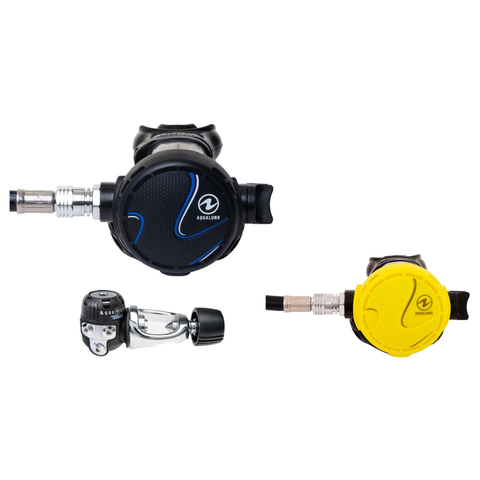
The Aqualung Titan is a balanced-diaphragm first stage and second stage regulator built for rental fleets and personal dive kits, available in DIN or Yoke connection, with a 300 bar DIN / 232 bar Yoke maximum working pressure.
Who it is for
The Titan's balanced-diaphragm first stage uses a T-shape mechanism, with a long service history in rental fleets and personal kit. The second stage pairs an in-line Venturi knob with the Comfo-Bite mouthpiece, a bridged design that stays in place without clenching, making it a straightforward everyday regulator for divers who want a low-maintenance set.
Key details
- First stage: balanced diaphragm, T-shape mechanism, wet chamber, marine brass body with bright chrome plating
- Ports: 2 high-pressure (7/16 in UNF) and 4 medium-pressure (3/8 in UNF) ports oriented in a "T" shape
- Max working pressure: 300 bar DIN / 232 bar Yoke
- Intermediate pressure: 9.5 bar ± 0.5 bar (137 ± 7 psi)
- Flow rate: 1,450 l/min (51.2 cu ft/min) at 200 bar
- Second stage: downstream poppet, cracking effort 2.5 to 4 mbar, average work of breathing 1.0 joules/liter
- Filter: sintered bronze conical; O-rings: EPDM; mouthpiece: silicone Comfo-Bite; material: strong polycarbonate
Compatibility and sizing
The Titan is offered in two connection options: DIN (SKU RG128112, barcode 886957926187) and Yoke (SKU RG128111, barcode 886957925661). The first stage's open-yoke screw design helps prevent water retention.
DiveCatalog.com is an authorized Aqualung dealer and a dive shop in Irvine, California since 2003. Call 888-701-4017 or start a chat if you have questions about DIN versus Yoke fit or compatibility with your current setup.
- Balanced Diaphragm First Stage: The balanced diaphragm mechanism supports consistent breathing performance while protecting internal moving parts from the environment.
- Forged Body: The Titan's forged body uses less brass for a compact first stage.
- Polyurethane Purge Cover: Rugged, durable polyurethane purge cover is abrasion-resistant, tear-resistant, minimizes inhalation effort, allows easy water purging, and helps protect against shock.
- HP/MP Ports in "T" Shape: 2 HP ports (7/16 in) and 4 MP ports (3/8 in) are oriented in a "T" shape for streamlined hose positioning, reduced exhalation effort, and bubbles directed out of the field of view.
- Water Retention Control: An open-yoke screw helps prevent water retention.
- Comfo-Bite Mouthpiece: A soft yet sturdy silicone mouthpiece reduces jaw fatigue with its palate bridge design.
- Reusable Mouthpiece Clip: Allows quick and easy mouthpiece changes using a removable, reusable clip.
- Clipped Deflector: Simplifies maintenance with a reduced number of components and easy access to the exhaust valve; the deflector also splits up bubbles to decrease noise and protect the valve from expiration.
- In-Line Venturi Knob: An ergonomic Venturi knob allows precise adjustments even while wearing gloves.
- Material Strength: Made of strong polycarbonate.
| Brand | Aqua Lung |
| Model | Titan |
| First Stage | Balanced diaphragm, T-shape mechanism, wet chamber |
| Max Working Pressure | 300 bar DIN / 232 bar yoke |
| HP Ports | 2 (7/16 in UNF) |
| MP Ports | 4 (3/8 in UNF) |
| Intermediate Pressure | 9.5 bar ± 0.5 bar (137 ± 7 psi) |
| Flow Rate | 1,450 l/min (51.2 cu ft/min) at 200 bar |
| First Stage Body | Marine brass, bright chrome plated |
| Filter | Sintered bronze conical |
| O-Rings | EPDM |
| Second Stage | Unbalanced demand valve, downstream poppet |
| Cracking Effort | 2.5 to 4 mbar (36 to 58 mpsi) |
| Venturi Knob | Yes |
| Mouthpiece | Silicone |
| ACD System | No |
| Work of Breathing | Avg. 1.0 joules/liter |
⚠️ WARNING: This product contains chemicals known to the State of California to cause cancer, birth defects, or other reproductive harm. For more information, visit www.P65Warnings.ca.gov.
Frequently Asked Questions
How often does a scuba regulator need servicing?
Follow the interval in your regulator's manual, since manufacturers commonly specify an annual inspection or a set number of dives and many warranties depend on it. A regulator is life-support equipment, so service belongs with a factory-trained technician rather than being attempted at home. Have it looked at sooner than scheduled if you notice increased breathing effort, free-flow, bubbles, or water in the second stage.
How do I rinse and care for a regulator after diving?
Make sure the dust cap is dry and firmly seated over the first-stage inlet before the regulator goes anywhere near water, because water inside the first stage is the leading cause of internal corrosion. Rinse in fresh water without pressing the purge button, since purging while depressurized can draw water back into the second stage. Shake out the water and hang it to dry with the hoses in wide, gentle loops rather than tight bends.
Can I fly with a scuba regulator?
Regulators travel well and are usually best carried in hand luggage where they will not be crushed or lost. A regulator holds no gas of its own, so there is nothing inherently problematic about it on an aircraft, though the airline and security screeners always have the final say. Pack it dry with the dust cap in place, in a padded regulator bag or wrapped in soft gear.
Can I use my regulator with nitrox?
Many modern regulators are supplied as suitable for nitrox mixes up to 40 percent oxygen, which is the widely used recreational industry standard, while anything above that requires dedicated oxygen-clean equipment and procedures. Confirm what your specific regulator's manual states, and follow your nitrox training and your fill station's requirements. Never assume a regulator is oxygen-service clean simply because it looks clean or is new.
What is the difference between DIN and yoke regulators?
A yoke (A-clamp) fitting clamps over the tank valve and is the most common connection across much of the recreational world, while a DIN fitting screws into the valve and is standard in much of Europe and in technical diving. DIN captures the o-ring inside the threads, which many divers consider more secure, but yoke is often what rental cylinders provide. Adapters exist in both directions, so check what is used where you dive before deciding.
What is the octopus regulator for?
The octopus is your backup second stage, carried so you can share air with a buddy who is out of gas, or breathe from it yourself if your primary fails or free-flows. It is normally on a longer, brightly colored hose so it is easy to find and hand over under stress. Secure it in the triangle between your chin and the bottom of your rib cage so it is instantly accessible and not dragging through sand or coral.
How should I store a regulator between dive trips?
Store it fully dry, out of sunlight, with the dust cap in place and the hoses in wide loops rather than tightly coiled. Avoid hanging it by the second stages for long periods, which stresses the hose fittings; laying it flat in a padded bag or hanging it by the first stage is kinder. If it has sat unused for a long stretch, have it checked before your next trip rather than assuming it is ready to dive.
Is the Aqualung Titan available in DIN or Yoke?
Yes, the Titan is sold in both connection types. The DIN version is SKU RG128112 (barcode 886957926187), and the Yoke version is SKU RG128111 (barcode 886957925661). The DIN version is SKU RG128112 (barcode 886957926187) and the Yoke version is SKU RG128111 (barcode 886957925661).
How many ports does the Titan first stage have?
The first stage has 2 high-pressure ports (7/16 in UNF) and 4 medium-pressure ports (3/8 in UNF), arranged in a "T" shape for streamlined hose positioning and reduced exhalation effort.
What is the Titan mouthpiece made of?
The second stage uses a silicone Comfo-Bite mouthpiece. It is a bridged design intended to stay in place without clenching, and it can be swapped using a removable, reusable clip.