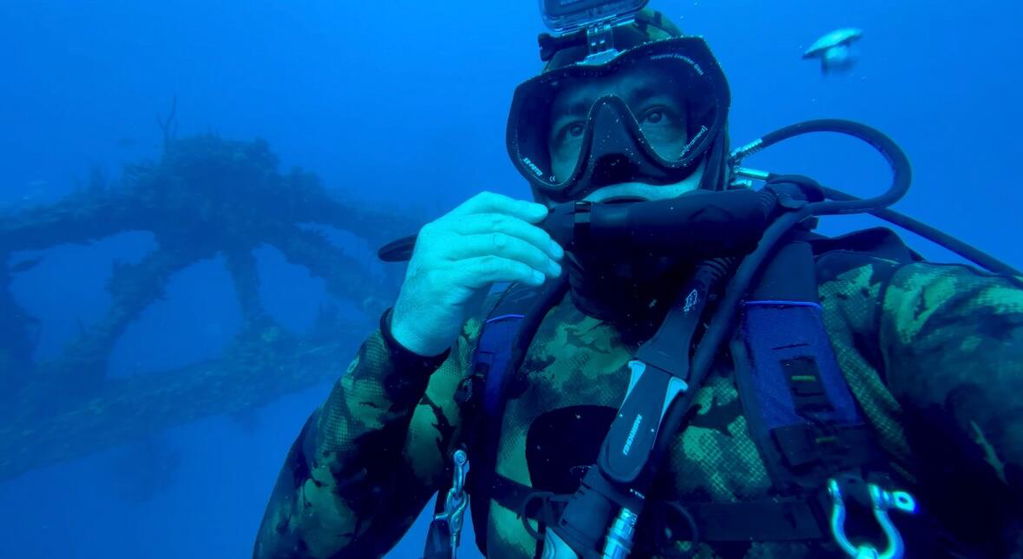
Almost every marine animal that injures a diver was minding its own business first. That is the pattern in the case reports, and it is the pattern I see on dive boats: a scorpionfish that nobody looked for, a cone shell that looked too pretty to leave alone, a lionfish handled by someone who had never handled one before. Very few of these animals are hunting you. Most of them are defending themselves, and the trigger is contact.
Which is convenient, because the same rule that keeps you out of an emergency room also keeps the reef intact. Hands off is a safety practice and a conservation practice at the same time. This guide covers the species most likely to hurt a recreational diver, how to recognize them in the water, what current first aid guidance says, and the small equipment choices that make accidental contact much less likely.
Why hands-off is a conservation rule first
Divers Alert Network's hazardous marine life reference flags poor buoyancy control as a common thread in both fire coral incidents and reported skin abrasions, which should tell you where to invest your effort. A diver who can hold a stable position 3 feet off the bottom is not going to kneel on fire coral, is not going to put a hand down on an urchin, and is not going to break the coral they came to look at.
Corals are colonies of living animals with a thin tissue layer over a calcium carbonate skeleton. A hand on that surface removes the protective mucus, abrades the tissue, and opens the colony to infection. Sponges, tunicates, and the mantle tissue of giant clams are similarly fragile. Almost nothing on a reef benefits from being touched, and almost nothing on a reef needs to be touched.
Stinging cnidarians
Fire coral (Millepora spp.)
Despite the name and the calcareous skeleton, fire coral is not a true coral. It is a hydrozoan — more closely related to the Portuguese man-of-war than to the brain coral next to it. Colonies are usually yellow-green to brownish and branchy, but appearance varies enormously with conditions, and Millepora will colonize hard structures until it takes on a stony, rust-colored look with no branches at all. That is the version that catches people out.
Contact fires nematocysts embedded in the skeleton. The burning lasts several hours, and a rash typically appears minutes to hours later and can take days to clear — sometimes reappearing weeks after it first resolved. The serious version is a fire coral laceration, where venom is delivered into an open wound; Millepora venom has documented dermonecrotic effects, so wound edges can become necrotic. DAN's guidance is to rinse the area with household vinegar, leave any blisters intact to dry naturally, keep the area clean and aerated, and get open wounds evaluated by a physician — and to tell that physician about the necrosis risk before anyone sutures anything.
Portuguese man-of-war (Physalia spp.)
Not a jellyfish but a siphonophore — a colony of specialized polyps under a gas-filled float. If you see blue tentacles, you are looking at Physalia. Atlantic specimens carry tentacles averaging around 33 feet (10 meters), and they can extend to roughly 165 feet (50 meters). Approximately 10,000 cnidarian envenomations occur each summer off the Australian coast, the vast majority involving Physalia, which makes it the leading cause of cnidarian stings prompting emergency evaluation worldwide.
The practical point for divers concerns the water column: most man-of-war stings happen at or near the surface, not at depth. Look up and around throughout your ascent, and pay particular attention to the last 15 to 20 feet, where trailing tentacles sit. In waters where they are endemic, a hooded vest protecting the neck is worth more than any other single piece of exposure gear.
Box jellyfish (Cubozoa)
Cube-shaped medusae with up to 24 eyes, some with corneas and retinas, which lets them see and steer around obstacles rather than simply drift. The sea wasp (Chironex fleckeri) of northern Australian and Southeast Asian waters is the most dangerous cnidarian known: a bell around 8 inches (20 centimeters) across, tentacles reaching about 10 feet (3 meters), and envenomation that can cause cardiac failure in as little as three minutes. Australia recorded more than 60 box jellyfish fatalities between 1884 and 1996. Species exist in nearly all tropical and subtropical seas, but the life-threatening ones are largely confined to the Indo-Pacific.
Irukandji syndrome comes from much smaller cubozoans — Carukia barnesi and Malo kingi — whose bells are only millimeters across. A single sting is rarely fatal but produces severe generalized pain and cardiovascular instability that needs immediate medical attention.
Prevention is unglamorous and effective: research the season and the site, minimize exposed skin, and carry household vinegar to the dive site. For any suspected box jellyfish sting, activate emergency services first, apply vinegar generously for at least 30 seconds, rinse with seawater rather than freshwater, then move to hot water immersion.
Venomous spines and barbs
Lionfish and scorpionfish

Lionfish (genus Pterois) carry needle-like venomous spines along the dorsal, pelvic, and anal fins. They are not aggressive and they are not a threat to a diver who keeps a reasonable distance — which is why nearly every documented injury traces back to handling, usually during culling or while cleaning the fish. In the western Atlantic, where P. volitans and P. miles have spread from roughly Rhode Island to Venezuela since the early 1990s, culling tournaments have become common; DAN staff reviewing four years of Cozumel tournaments recorded injury rates between 7 and 10 percent of participants.
Punctures produce intense pain, rapid swelling, and subcutaneous bleeding. Finger wounds are the ones to worry about, because edema plus venom toxicity can produce ischemia and tissue necrosis. If you are stung underwater, end the dive normally — a normal ascent rate, no skipped decompression obligations — and treat on the surface.
Stingrays
Stingrays are shy and pose no threat to a diver who does not startle, step on, or corner them. An estimated 1,500 stingray injuries occur in the United States each year, most in shallow water where someone walked onto a buried animal. The serrated barb sits at the tail base over venom glands, tears through neoprene easily, and frequently breaks off in the wound, which is why these injuries so often need surgical care and carry a high infection risk. Because the venom is a variable mix of non-specific compounds, an antivenom is not possible.
On shore entries in sandy or low-visibility shallows, shuffle your feet rather than stepping. The vibration moves rays off before you reach them.
Sea urchins
Urchin spines are calcium carbonate, hollow, and brittle. They punch through boots and wetsuits, snap off under the skin, and are frustrating to remove — DAN's medical information line takes at least one call a week about them, mostly from divers and snorkelers in shallow water near rocky shores. Contrary to the usual assumption, very few urchin species are venomous; the pain and swelling are largely an inflammatory response to antigens on the spine surface. Multiple punctures from long-spined Diadema species can produce limb weakness.
The exception worth knowing is the flower urchin (Toxopneustes spp.), whose short spines are harmless but whose flower-like pedicellariae are venomous claws capable of causing severe pain, breathing difficulty, and numbness of the lips and tongue. It is the most toxic urchin in the ocean and it looks like a bouquet.
The small ones that deserve the most respect
Blue-ringed octopus (Hapalochlaena spp.)
Rarely more than 8 inches (20 centimeters) across, endemic to southern Japan, Australia, and the western Indo-Pacific. The iridescent blue rings that everyone recognizes only appear when the animal is disturbed, hunting, or mating — at rest it is a drab yellowish, grey, or beige octopus that looks like nothing in particular. That is the identification problem in a sentence.
Its bite may carry tetrodotoxin, a neurotoxin up to 10,000 times more potent than cyanide; roughly half a milligram, an amount that fits on a pinhead, is theoretically enough to kill an adult. The bite itself is often painless or no worse than a bee sting, and the first symptoms are tingling and numbness of the lips and tongue progressing toward paralysis. There is no antivenom, and because tetrodotoxin is heat-stable, hot water immersion does nothing. Care is supportive: clean the wound, apply pressure immobilization, watch for progressive paralysis, be ready to ventilate, and get to an emergency department without waiting for symptoms.
Envenomations are genuinely rare, and divers should not be afraid of these animals. Just do not handle them, and in regions where they live, do not pick up bottles, cans, or empty shells — a blue-ringed octopus den can be any small cavity.
Cone snails (Conus spp.)
About 600 species, all venomous, living in shallow reefs and partially buried in sand, rubble, and coral in tropical and subtropical water. A cone snail stings by extending a proboscis and firing a harpoon-like radular tooth. Injuries occur when the animal is handled, which in practice means shell collecting. Conotoxins act on the nervous system and can cause paralysis and respiratory failure; there is no specific treatment and no antivenom, and heat will not help because the venom mixture includes tetrodotoxin.
The field rule is simple. If you find a beautiful cone-shaped shell, assume a living cone snail is inside it and leave it where it is.
Three first aid patterns worth memorizing
Most marine envenomations a recreational diver will encounter fall into one of three response categories.
- Heat-labile protein venoms — lionfish, scorpionfish, stingrays, urchins, most jellyfish stings. Immerse the affected area in hot water at an upper limit of 113°F (45°C) for 30 to 90 minutes. Test the water on yourself first; severe pain impairs the patient's ability to judge temperature, and scalding a numb limb is a real risk.
- Nematocyst stings — man-of-war, box jellyfish, fire coral. Do not rub. Never rinse with freshwater, which triggers mass nematocyst discharge. Remove tentacles carefully, flush with seawater, apply vinegar where indicated, then heat.
- Heat-stable neurotoxins — blue-ringed octopus, cone snails. Hot water is useless. Pressure immobilization, airway monitoring, and immediate transport are the whole protocol.
Every one of these also needs professional medical evaluation. Marine puncture wounds are notorious for infection, and tetanus boosters and antibiotics are common follow-ups.
Gear that keeps contact from happening
Exposure protection is the most underrated safety equipment in tropical diving, because divers choose it for warmth and then discover it also handles stings, abrasions, and hydroid rashes. A full-length suit covers the surface area where most incidental contact happens. If a 3mm feels like too much in 84°F water, a lightweight long-sleeve rash guard or dive skin under a shorty gives you mechanical coverage without the thermal load, and the full range of wetsuits lets you match thickness to water temperature rather than splitting the difference. In waters known for man-of-war or box jellyfish, add a hooded vest — the neck and jawline are the areas people forget.
Dive gloves are the more nuanced case. They prevent abrasions and hydroid stings on shore entries, wreck dives, and cold-water rock scrambles, and a thin tropical glove like the Scubapro Tropic 1.5mm adds protection without killing dexterity. But some destinations prohibit gloves specifically because gloved divers touch more. Check the operator's protocol before you travel, and if you wear them, treat them as protection against accidents rather than permission to hold on to things.

A light is the identification tool. Water strips red wavelengths within the first few meters, so a scorpionfish sitting on rubble at 60 feet is a grey lump in ambient light and an obvious animal under a beam. Anything in the 1000-lumen range with a usable beam angle does the job — the Sherwood ST1000 is a common choice for exactly this — and the broader dive lights range covers everything from pocket backups to primary torches. Use it to look into crevices before you put a hand anywhere near one, which on a night dive is not optional.
The habit that ties it together
Buoyancy is the intervention. Fire coral stings, urchin punctures, coral abrasions, and stingray encounters share one cause: a diver ended up somewhere they did not intend to be. Weighting yourself correctly, trimming flat, and knowing where your fins are will prevent more injuries than any first aid kit will treat.
Beyond that, adopt the field rule that working marine biologists use without thinking about it: identify first, approach second, and never touch. A cone shell, a resting octopus, a flower urchin, a scorpionfish on rubble — all of these are safe to look at from a foot away and unsafe to pick up. The animals get to keep their day, and you get to keep yours.
This article is general information for recreational divers and is not a substitute for professional medical training or advice. For dive-specific medical guidance, consult Divers Alert Network or a physician trained in dive medicine.