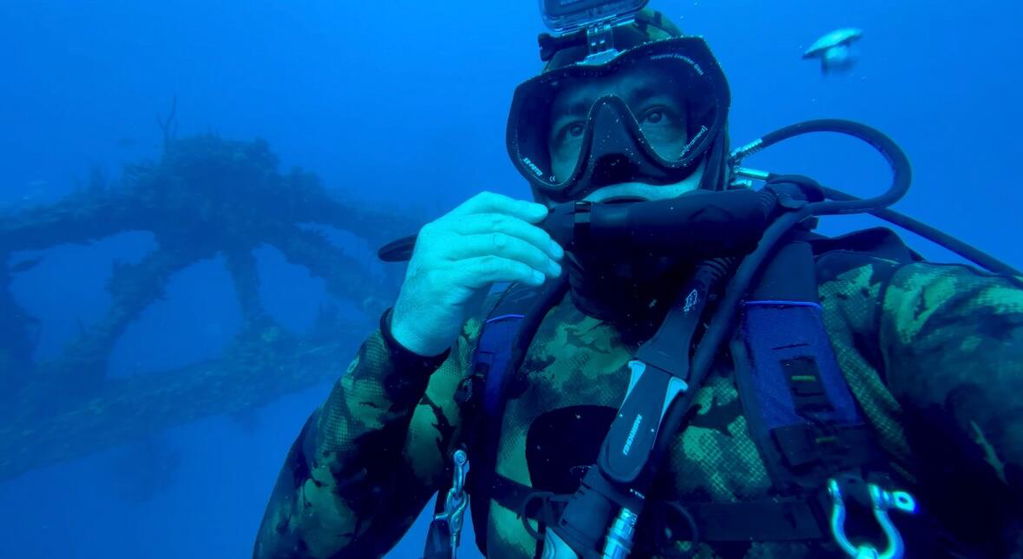
Most divers who come to freediving from scuba bring their scuba mask with them, and most of them discover the problem at about 15 meters: a face that feels like it's being pulled into the lenses, and a growing share of their one breath spent blowing air through their nose to fix it. The mask is the first piece of scuba gear that stops working once you take away the tank.
Choosing a freediving mask comes down to three decisions: internal volume, fit, and lens type. Get the first two right and the mask disappears on the dive, which is exactly what you want from it. This guide works through each, then covers the snorkel, because the same logic applies and the wrong one is just as common.
Why volume is the number that matters
Every mask traps a pocket of air between the lenses and your face. As you descend, pressure compresses that pocket: by 10 meters (33 feet) the ambient pressure has doubled and the air in your mask occupies half the space it did at the surface. If you don't replace it, the mask pulls against your face and eyes — mask squeeze — and at depth it becomes painful and eventually dangerous.
On scuba you fix that with a small exhale through your nose, and you never think about it because your gas supply is effectively unlimited. On a breath-hold dive every milliliter you push into the mask comes out of the lungs you're diving on. A typical recreational scuba mask holds somewhere in the region of 150 to 200 ml of air. A purpose-built freediving mask holds roughly 70 to 100 ml. Over a 30-meter dive, that difference is real air you either keep for the ascent or blow into a pocket of plastic.
The second benefit is easier to feel than to measure: a smaller volume means less compression to equalize per meter, so you can do it in fewer, smaller exhales, and the mask stays comfortable through the free fall when you're trying to relax rather than manage gear.

How low-volume masks get there
Manufacturers cut volume in a few consistent ways. The lenses sit closer to your eyes, usually with a two-lens design that lets each lens tuck into the eye socket rather than a single flat pane held out in front of the nose. The skirt is shorter and the nose pocket is smaller. Some masks drop the rigid frame entirely and bond the lenses straight into the silicone, which lets the whole thing sit tighter to the face.
The trade-off is field of view. A low-volume mask shows you a little less of the periphery than a wide scuba mask. Most freedivers and spearos accept that immediately; the gains on the dive outweigh the extra few degrees at the edges. If you plan to use one mask for both scuba and freediving, a compact dual-lens design is the sensible compromise.
Fit: the test that decides everything
Volume is the spec on the box. Fit is the thing that determines whether the mask floods every time you smile, and it can't be read off a product page. Two masks with identical volume will fit the same face completely differently because skirt shape varies between brands and models.
The suction test
- Hold the mask against your face with the strap out of the way — don't put it on.
- Inhale gently through your nose and hold.
- Let go with your hands and look down.
A mask that fits will stay on your face under that light suction alone. If it drops or you feel air leaking in at the temples, the bridge of the nose, or under the cheekbones, it doesn't fit, regardless of how it looks. Do the test with your hair pushed back and, if you dive with a hood, ideally with the hood on, because the hood changes the seal at the temples and forehead.
Nose pocket and equalizing
You need to be able to pinch your nose through the pocket easily, with the hand you'll actually use, and with gloves if you dive in them. On a low-volume mask the pocket is small by design, and some are noticeably tighter than others. If reaching your nostrils takes effort in the shop, it will take more effort at 20 meters with cold hands, and every fumbled equalization is a dive cut short.
Strap and buckles
Buckles mounted on the skirt rather than the frame let the strap pull the skirt directly against your face, which improves the seal and lets the mask flex with your expression. A wide split strap seats better on a bare head; if you always wear a hood, most divers prefer the strap over the hood so the mask can be adjusted and ditched without touching the neoprene. Either way, the strap should be snug enough to hold the mask in place at the surface and no tighter — at depth, water pressure does the rest, and an overtightened strap only causes leaks by distorting the skirt.
The Tusa Lapis Freediving Mask is a good example of the current design language: minimal internal volume, a skirt that brings the lenses close to the eyes, a frame-separated buckle system so the strap pulls on the skirt, and a matte finish on the frame, skirt, and straps that cuts reflections. It's also priced where a first dedicated freediving mask should be, and it fits a wide range of faces, which is why it's the first thing we hand people who ask.

Minimal internal volume, skirt-mounted buckles, and a matte anti-reflective finish. Fits a wide range of faces and makes a strong first freediving mask.
From $58.00 · View product →
Lenses: clear, mirrored, tinted, and prescription
Tempered glass, always
Dive masks use tempered glass lenses, and any mask sold for freediving or spearfishing should too. Tempered glass resists scratching and, if it does break under impact, crumbles into blunt granules rather than shards. Polycarbonate or acrylic lenses belong on kids' pool masks and nowhere near a spearing session.
Clear lenses
The default and the right choice for most freedivers. Maximum light transmission, true color, and your buddy can see your eyes on the surface — which matters more than it sounds during a blackout check, when your safety diver needs to read your face in the first seconds after you surface.
Mirrored lenses
Mirrored coatings do two things. They cut glare in bright, shallow water, and they hide your eyes from fish. Many species react to eye contact and to the flash of a diver's eyes tracking them, and a mirrored lens removes that cue while you're lying still on the bottom. For reef and open-water spearfishing in good visibility they're a real advantage. The cost is light: mirrored lenses transmit less of it, so in murky, deep, or overcast conditions they can leave you working in the dark. They also make it harder for a buddy to see your eyes, which is the same safety point in reverse.
The Seac Eagle S Compact Low Volume Mask is built for freediving and spearfishing and is offered in both clear and mirrored versions, with 3D swiveling buckles that adjust easily in thick gloves and a semi-rigid case with a carabiner included. It also takes optional prescription lenses, which brings up the last option.

Seac Eagle S Compact Low Volume Mask
Clear or mirrored lenses, glove-friendly swiveling buckles, and optional prescription lenses. Semi-rigid case included.
From $90.85 · View product →
Prescription lenses
Contact lenses work underwater for many divers but can be lost when a mask floods, and a flooded mask is a normal event in freediving. If your vision is poor enough that you'd struggle to find the float or read a buddy's hand signals without correction, look for a dual-lens mask that accepts optical lenses. Dual-lens designs are the ones that can be corrected, since each lens is swapped independently; single-lens frameless masks generally can't be.
Skirt color: black or clear?
Clear silicone lets in more ambient light and feels more open, which some new divers prefer. Black or dark skirts block light from the sides, which reduces glare and reflections on the inside of the lens and lets your eyes focus on what's in front of you — the same reason photographers use a lens hood. For spearfishing, a dark skirt also reduces the amount of your face that's visible to fish. Almost every dedicated freediving and spearfishing mask uses an opaque skirt, and that's the right default.
The snorkel: simpler is better
Modern snorkeling snorkels have accumulated features — dry-top valves, splash guards, purge valves, flex sections, corrugated tubes. For freediving and spearfishing, every one of those is a liability.
A freediver takes the snorkel out of the mouth before the duck dive and leaves it out until surfacing. There are two reasons. If you black out with a snorkel in your mouth, the tube gives water a direct path into your mouth and airway, and it gets in the way of the rescue breaths your buddy needs to deliver. And on the ascent, your first breath should be a clean recovery breath into open air, not a lungful of water from a flooded tube. So a freediving snorkel is a surface breathing tool only, and it needs to do exactly one thing well: deliver a big, easy breath during the breathe-up with nothing in the way.
That means a plain J-tube with a wide bore, a simple mouthpiece, and no valves. Dry tops can hold a bubble of air that resists the strong inhale of a breathe-up. Purge valves add a failure point and rattle. Flex sections trap water and create drag and noise on the dive, and noise is what tells the fish you're there. Corrugated tubes turn drag into a whistle. The best freediving snorkels are the most boring-looking ones on the wall.
The Scubapro Apnea Foldable Open Top Snorkel is that kind of snorkel: a soft silicone J-tube with an open top, a removable upper barrel if you want a shorter pipe, and a fold-flat body that stows in a pocket or under a belt when you're not using it. For spearos who want a stiffer, more hydrodynamic tube with a sound-damping profile, the Mares Pure Instinct Dual Snorkel uses a bi-material tube — rigid where it needs to hold shape, soft where it meets your face — and comes in the muted greens, browns, and blacks that don't flash on a reef.

Scubapro Apnea Foldable Open Top Snorkel
Soft silicone open-top J-tube with a removable upper barrel. Folds flat to stow in a pocket or under a belt.
From $27.00 · View product →
Where to carry it
Snorkel keepers clip the tube to your mask strap, which is fine for surface swims but leaves the snorkel dragging along your head and catching on the float line during the dive. Many freedivers and most spearos tuck the snorkel under the mask strap loosely so it can be pulled out and stowed under the hood or belt on the descent, or simply hold it in one hand. Whatever you choose, practice it so it's automatic before the duck dive. You'll find the full range in freediving snorkels.
Before the first dive: prepping a new mask
New masks arrive with a thin film of silicone residue on the inside of the lenses left over from manufacturing. Until it's removed, no defog will hold and the mask will fog within minutes on every dive. Rub a small amount of plain white toothpaste (not gel, nothing with whitening grit) over the inside of each lens with a fingertip, leave it for a few minutes, and rinse thoroughly. Repeat once or twice. Skip the lighter method some divers use — an open flame can craze the glass and will damage coated lenses — and stick with toothpaste.
After that, a commercial defog or a drop of baby shampoo rubbed in and rinsed lightly before each session will keep the lenses clear. Rinse the mask in fresh water after every dive, dry it out of direct sun, and store it in its case so nothing presses on the skirt. Defog, spare straps, and cases are in mask accessories.
Common questions
Can I use my scuba mask for freediving?
For a pool session or a shallow snorkeling reef, yes. Once you're diving past 10 to 15 meters, the extra volume costs you air on every dive and makes the descent noticeably less comfortable. A dedicated low-volume mask is the single most affordable upgrade in the sport.
What internal volume counts as low volume?
There's no formal standard, but masks marketed for freediving generally sit in the region of 70 to 100 ml, against roughly 150 to 200 ml for a typical scuba mask. Fit matters more than a few milliliters either way; a 90 ml mask that seals beats a 75 ml mask that leaks.
Are mirrored lenses worth it for spearfishing?
In clear, bright water where you're hunting wary fish on the bottom, yes. In low visibility or deep, dim water, no — you'll lose more from the reduced light than you gain from hiding your eyes. Many spearos own both and pick by conditions.
Should I use a dry snorkel for freediving?
No. A dry-top valve resists the strong inhale of a proper breathe-up and adds bulk and noise. Use a simple open-top J-tube, and take it out of your mouth before every dive.
How tight should the mask strap be?
Just tight enough to hold the mask in place at the surface. Water pressure seals it as you descend. An overtightened strap distorts the skirt and causes the leaks it was meant to prevent, and it leaves a mark that lasts the whole boat ride home.
Where to start
If you're buying one mask: a dual-lens low-volume design with clear tempered lenses and a dark skirt, chosen by the suction test rather than the color options. Pair it with a plain open-top J-tube snorkel, and do the toothpaste prep before the first session. That setup covers depth training, recreational freediving, and spearfishing without compromise.
Browse the full range in freediving masks and freediving snorkels, or work through the rest of the kit in freediving and spearfishing. If you're still building out your setup, our guides to choosing freediving fins and open cell vs. lined freediving wetsuits cover the other two pieces that shape every dive.
A mask you don't notice is the goal. Choose by volume, confirm by fit, and everything else is preference.