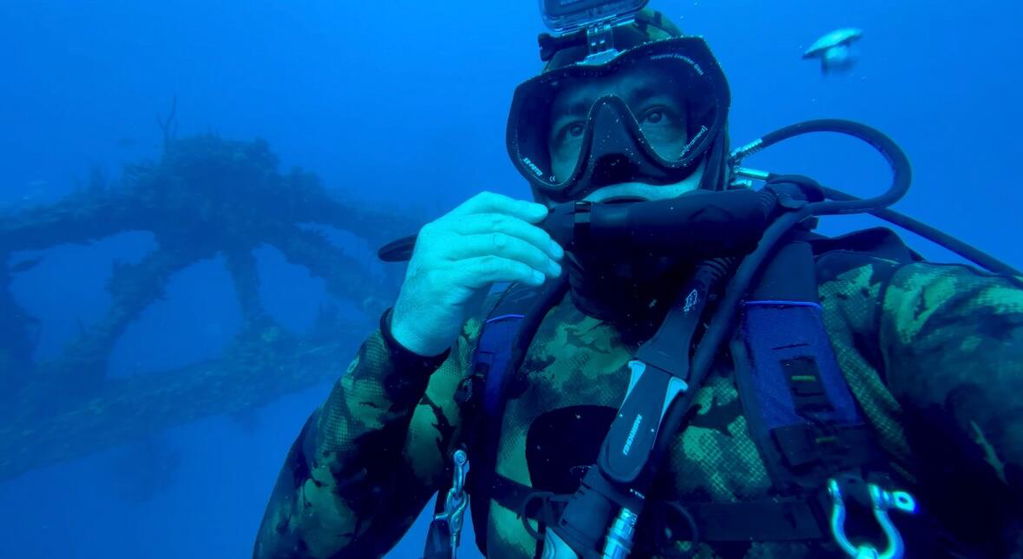
Cold ends more dives than lung capacity does. You can train apnea all winter, dial in your Frenzel, and buy the right blades — but if you're shivering at the end of the second hour, your dive time collapses and your recovery gets worse with every drop. The wetsuit is the piece of gear that quietly sets the ceiling on your session length.
Freediving and spearfishing wetsuits are also built differently from scuba wetsuits, in ways that aren't obvious from a product photo. Choosing one comes down to four decisions: open cell vs. lined interior, one-piece vs. two-piece cut, thickness, and fit. Here's how to work through each.
Open cell vs. lined neoprene
This is the single biggest difference between a freediving suit and the scuba suit you already own, and it's the one most divers get wrong on their first purchase.
Open cell interior
Open cell neoprene has no nylon lining on the inside. The raw neoprene cells sit directly against your skin and effectively suction to it, which means almost no water circulates between suit and body. Less flushing means less heat loss, and an open cell suit will noticeably outperform a lined suit of the same thickness.
The tradeoffs are real. Open cell neoprene has poor tear resistance, has to be lubricated to put on, and takes more care in handling. But for breath-hold diving — where you're spending hours at the surface between dives rather than moving continuously at depth — the thermal gain is worth it.
Lined (closed cell) interior
A lined interior has nylon bonded to the inside face. It's tougher, it slides on dry, and it survives being hauled over a boat gunwale. It's also colder, because water moves more freely between the fabric and your skin.
Lined suits make sense in genuinely warm water, for divers who need to change quickly on a crowded boat, or as a durable first suit before you commit to open cell. The Seac Blue Sea 1.5 mm long suit is a good example — soft 1.5 mm neoprene with PU-print knee protection and Melco-taped seams, built for tropical water where you want sun and sting protection more than insulation.
Smoothskin vs. lined exterior
The outside of the suit matters too. Smoothskin (the glossy, rubbery finish) sheds water instantly, which cuts evaporative wind chill while you're floating between dives — a real factor on a windy boat day. Lined exteriors are more abrasion-resistant and survive rock entries, kelp, and boat decks far better.
Most spearfishing suits use a lined exterior with a printed camouflage pattern. Most depth-oriented freediving suits use smoothskin. If you dive from shore over rock, take the lined exterior.
Why freediving suits are two-piece

Almost every purpose-built freediving and spearfishing suit is a two-piece: an integrated-hood jacket plus high-waisted pants (sometimes called "long johns" or "farmer johns"). The design solves several problems at once.
- No zipper. Zippers leak, add stiffness across the chest, and restrict the diaphragm. A zipperless suit lets your ribcage and belly expand freely on the inhale — which matters when your whole dive runs on one breath.
- Double coverage at the core. The overlapping pant waist and jacket beavertail put two layers of neoprene over the torso, where you lose the most heat.
- Attached hood. No gap at the neck for water to flush through. A separate hood always leaks somewhere.
- Mix and match. You can wear the pants alone in warm water, or pair a thinner jacket with thicker pants.
The Seac Camo Snake 3 mm women's jacket and pant is a textbook execution of the format: 100% UltraStretch neoprene, glued and blind-stitched seams, open cell interior, hooded jacket over high-waisted pants, with smooth edges at the wrists and ankles to cut water entry.
Thickness: match the neoprene to the water
Thickness is where most divers either overbuy and cook, or underbuy and quit early. Because open cell runs warmer than lined neoprene, an open cell suit generally handles water one step colder than a lined suit of the same millimeter rating.
Reasonable starting points for open cell freediving suits:
- 1.5–2 mm — above roughly 81°F (27°C)
- 3 mm — roughly 75–81°F (24–27°C)
- 5 mm — roughly 65–75°F (18–24°C)
- 7 mm — roughly 55–65°F (13–18°C)
- 7 mm or thicker, or a semi-dry — below roughly 55°F (13°C)
Three adjustments to that table:
Session length. A one-hour training session and a five-hour spearfishing day are different problems. Long, low-output days in the water push you a step thicker than the chart suggests.
Activity level. Depth training on a line, where you spend most of the session floating and breathing up, is far colder than active reef hunting at the same water temperature.
Depth. Neoprene compresses under pressure. A 5 mm suit is meaningfully thinner — and less insulating — at 30 m than it is at the surface. Deep divers routinely feel cold that surface temperature doesn't predict.
For temperate water where you might dive both summer and shoulder season, a 5 mm open cell two-piece is the most versatile single suit most divers own.
Fit: the spec that matters most
An open cell suit only works if it's tight. The insulation comes from the neoprene sealing against your skin, so any gap becomes a pocket of circulating water and a cold spot. A 5 mm suit that fits badly is colder than a 3 mm suit that fits well.
What to check:
- Torso length. The most common fit failure. If the suit is too short in the body, the crotch pulls down and the hood pulls back off your forehead. Manufacturer sizing is usually driven by height and chest, not weight alone — check both.
- Hood seal. The hood should sit against your forehead and cheeks with no gap at the face opening, and it should not compress your throat. A hood that presses on the carotid area is a safety problem, not just a comfort one.
- Wrists and ankles. Smooth-edge cuffs should seal on skin. Any looseness here flushes cold water through the whole suit on every duck dive.
- Shoulders and chest. You need full arm rotation for finning and gun handling, and you need to be able to take a maximum inhale without the suit fighting you. If a full breath feels restricted on land, it will feel worse on the surface before a dive.
Try the suit on with the socks and gloves you'll actually dive in. Sizing between two options is a hard call; if you're between sizes with an open cell suit, most divers do better going down, because open cell stretches to the body and a loose suit never gets warmer.
How much lead a wetsuit adds
Neoprene is buoyant, and every millimeter you add has to be offset with lead. That changes your weighting significantly.
The freediving convention is to weight yourself for neutral buoyancy at around 10 m (33 ft), not at the surface. That gives you positive buoyancy where safety matters most — the last 10 m of an ascent, when you're most likely to black out — while still letting you free-fall below the neutral point.
As a rough guide, divers in a 3 mm suit commonly carry somewhere around 6–8% of body weight in lead; a 7 mm suit can push that to 10% or more. Treat those as starting numbers only. Do a proper buoyancy check in the conditions you'll dive, and adjust in 0.5 kg / 1 lb increments until you're neutral at about 10 m. Salt water requires more lead than fresh.
Pair the suit with a rubber freediving belt rather than a nylon scuba belt — rubber grips the neoprene and stays on your hips through the pressure changes instead of riding up onto your ribs. Browse dive weights and belts to sort that out before your first session in a new suit.
Camouflage, and whether it matters

Camo patterns aren't marketing alone, but they're also not magic. Fish detect contrast and movement far better than pattern detail, so a camo suit reduces your visual signature at range — most useful when you're holding still on the bottom waiting for fish to close. Match the pattern to your environment: blue for open and blue water, green or brown for kelp, reef, and murk.
Stillness and breath discipline outperform any pattern. Camo helps at the margin.
In genuinely warm water, a fabric two-piece can replace neoprene entirely. The Seac Blue Moon two-piece uses an 85% polyester / 15% spandex ultra-stretch blend in a blue camouflage pattern, with an integrated hooded jacket, high-waisted stirrup pants, PU-print knee protection, and Melco tape sternal support for loading. It works as a standalone tropical suit or as a stealth layer over neoprene.
For layering under a jacket, or for warm-water dives where you want sun protection and a little insulation without the bulk, a 1.5 mm neoprene top like the Scubapro Everflex 1.5 mm long sleeve top (also available in a women's cut) pairs with matching bottoms to build a modular warm-water setup.
Getting into an open cell suit without destroying it
Open cell neoprene will not slide on dry, and forcing it is how divers tear a new suit in the parking lot. The fix is lubricant.
- Mix roughly one part hair conditioner to two parts water in a bottle. Conditioner is more slippery than soap and far less likely to cause skin irritation — avoid dish soap and shampoo.
- Seal the openings of the pants or jacket, pour the mix inside, and work it around until the entire interior is coated.
- Put the pants on first, easing the legs up a section at a time. Never pinch with your fingernails on the inside — grab the lined exterior only.
- For the jacket, get the hood on first, then work each arm through, then fold the beavertail under and secure it.
- To remove, fold the waist down or up, add water inside to break the suction, and roll the suit off rather than pulling.
The whole process takes about five minutes once you've done it a few times. Do it in the shade — warm neoprene and warm skin make it harder.
Care that extends suit life
- Rinse in cool fresh water after every session, inside and out. Salt crystals abrade open cell neoprene from the inside.
- Dry inside-out first, out of direct sun. UV degrades neoprene and fades printed camo.
- Store on a wide hanger or folded loosely — never on a thin wire hanger, which creases and eventually cracks the shoulders.
- Keep fingernails trimmed and remove rings before donning. Most open cell tears are self-inflicted.
- Repair small tears immediately with neoprene cement. A 5 mm tear becomes a 50 mm tear on the next dive.
- Never store the suit compressed in a gear bag while damp.
Common questions
Can I use my scuba wetsuit for freediving?
For a first few sessions in warm water, yes. Beyond that, the front or back zipper restricts your inhale, the lined interior flushes cold water, and the separate hood leaks at the neck. If you're diving regularly, a purpose-built two-piece is a significant upgrade in both warmth and comfort.
Is open cell worth the extra care?
If you dive water below roughly 78°F (26°C) or stay in for more than about an hour, yes. The warmth difference against the same thickness of lined neoprene is substantial. In genuinely tropical water on short sessions, a lined suit is easier to live with.
How long does a freediving wetsuit last?
Dived regularly and cared for properly, expect several seasons before the neoprene loses noticeable loft and warmth. Suits usually fail from UV exposure, compression storage, and donning tears long before they wear out from diving.
Do I need a thicker suit for deeper dives?
Often, yes. Neoprene compresses with depth, so its insulating value drops as you descend. Divers doing repeated deep dives frequently size up a step from what surface temperature alone would suggest.
Should I buy the suit before or after my weight belt?
Suit first, always. The suit determines how much lead you need, so weighting yourself before you own your exposure protection means redoing it.
Where to start
If you're buying your first dedicated suit: an open cell two-piece with a lined exterior, in the thickness your typical water calls for, sized tight rather than comfortable. That covers depth training and spearfishing, survives shore entries, and gives you an accurate baseline to weight against.
If you're upgrading from scuba neoprene: go open cell before you go thicker. Most divers who think they need more millimeters actually need better sealing.
Browse the full range in freediving wetsuits and spearfishing wetsuits, and round out the kit with a low-volume freediving mask, long blade fins, and freediving gloves. Everything else lives in freediving and spearfishing.
One standing rule regardless of what you wear: never freedive alone. A properly fitted suit keeps you in the water longer, and a trained buddy on the surface is what keeps that safe.