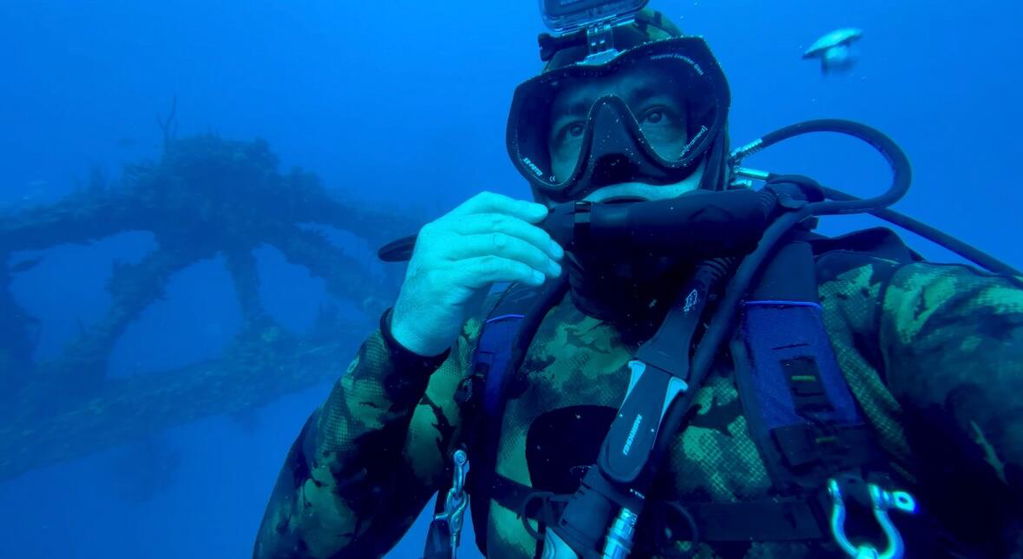
The Red Sea has been the workhorse dive destination of Europe and the Middle East for forty years, and it earns that reputation on the numbers alone: warm water twelve months a year, visibility that regularly runs past 30 meters, hard coral in better shape than most of the Caribbean, and one of the best-preserved wartime wrecks on the planet sitting at recreational depth. Flights from Europe are short and cheap enough that a week of liveaboard diving in Egypt often costs less than a week of resort diving in the Caribbean.
The complication is that "the Red Sea" covers a 1,000-mile coastline with wildly different diving at each end, and the single biggest decision you make is which route you book. This guide walks through the itineraries, when to go, what the marine parks require of you, how to vet an operator, and what gear actually earns its space in the bag.
The Egyptian Dive Hubs, and What Each One Is For
Almost all Egyptian Red Sea diving is sold out of four towns, and knowing which one your itinerary departs from tells you a lot about the diving you will get.
Sharm el-Sheikh, on the tip of the Sinai Peninsula, is the gateway to Ras Mohammed National Park and the Strait of Tiran. Ras Mohammed was designated in 1983 as Egypt's first national park, and Sharm's combination of walls, current-swept reefs, and the wrecks of the Strait of Gubal makes it the default choice for a first trip.
Hurghada, on the mainland coast opposite, serves the northern wrecks and reefs and has the largest airport and the widest range of budget boats. Marsa Alam, roughly four hours south, is the departure point for the offshore marine parks and the deep south itineraries. Dahab, north of Sharm, is a shore-diving and freediving town built around the Blue Hole and Canyon rather than a liveaboard port.
Choosing Your Route: North, Offshore, or Deep South
Northern Wrecks and Reefs
This is the classic first-timer itinerary, and it is the one to book if you want the SS Thistlegorm. The British merchant ship was bombed by German aircraft on 6 October 1941 while anchored in the Strait of Gubal, and she still holds her cargo: Bedford trucks, BSA motorcycles, rifles, aircraft parts, and two locomotives blown clear of the deck. The wreck sits upright between roughly 16 and 32 meters, which places most of the interesting cargo holds inside recreational limits.
The same route usually takes in the Abu Nuhas reef, where four freighters lie in a row on the northern slope, plus Ras Mohammed's Shark and Yolanda Reefs. Currents are moderate, depths are forgiving, and Open Water divers with a reasonable dive count can handle most of it.
The Offshore Marine Parks
Brothers Islands, Daedalus Reef, and Elphinstone are the reason experienced divers keep coming back. These are isolated pinnacles rising from deep water miles offshore, reachable only by liveaboard, and they attract the pelagic traffic to prove it: grey reef and scalloped hammerhead sharks, thresher sharks at Brothers, oceanic whitetips in the autumn months, and the occasional manta. Big Brother also holds two wrecks, the Numidia and the Aida.
These are blue-water drift dives in current, often with no bottom in sight. They are not the place to learn buoyancy, and the permitting rules reflect that (see below).
The Deep South
Fury Shoals, St. John's Reef, Rocky Island, and Zabargad sit near the Sudanese border and require a longer crossing. The trade-off is coral in genuinely excellent condition, swim-through systems, and far fewer boats. Dolphin encounters at Sataya and Samadai are a regular feature. Itineraries run out of Marsa Alam or Port Ghalib and usually need a full week.

When to Go
The Red Sea is diveable year-round, which is a large part of its appeal, but the conditions swing more than most people expect.
Water temperature runs from roughly 22°C (72°F) in February to 28–30°C (82–86°F) in August. Air temperatures in July and August regularly exceed 40°C (104°F) on the southern coast, which is genuinely uncomfortable on a steel dive deck.
March through May and September through November are the sweet spots. Seas are calmer, visibility is at its best, and the water is warm without the summer heat. These are also the months that sell out first, so book six to nine months ahead if you want a specific boat or route.
If sharks are the goal, plan around them rather than hoping. Hammerhead and thresher activity at Brothers and Daedalus concentrates in the warmer months, roughly June through November. Oceanic whitetips at Elphinstone are most reliable in October and November. Winter, by contrast, brings strong northerly winds that regularly cancel offshore crossings — captains will not run for the marine parks in sustained winds above about 28 knots, and itinerary changes for weather are normal from October to April.
What the Marine Parks Require From You
Egypt enforces real prerequisites on the offshore sites, and operators check logbooks.
Minimum dive count. Egyptian regulations require a minimum of 50 logged dives to dive the offshore island marine parks — The Brothers, Daedalus, Rocky Island, and Zabargad. Most operators additionally want Advanced Open Water certification and recent experience in current, and some require Nitrox certification for these routes. Bring a physical or digital logbook you can actually show.
Medical statement. Under CDWS (Chamber of Diving and Watersports) rules, every diver completes a medical statement, and a "yes" answer means you need a diving medical certificate less than a year old. Sort this out at home, not at the dock.
Park and port fees. Marine park entry and port charges are collected on board, typically in the range of US$100–150 per trip depending on the itinerary, and are usually cash-only in euros or dollars. Nitrox fills, gear rental, and crew tips are also cash. Budget several hundred dollars in cash per person beyond the trip price.
Entry. Most nationalities can obtain a visa on arrival, and the single-entry fee rose to US$30 on 1 March 2026. Egypt's e-visa is the alternative. Check your own passport's requirements before booking, since terms differ by nationality and by port of entry.
How to Vet a Liveaboard
This part matters more in Egypt than almost anywhere else. After a string of liveaboard losses in the Red Sea, the UK Marine Accident Investigation Branch issued a safety bulletin identifying recurring problems across the fleet: vessels substantially modified or extended in ways that compromised stability, defective lifesaving equipment, inadequate structural fire protection, and emergency escape routes that were unmarked or obstructed.
You cannot audit a shipyard from your laptop, but you can ask specific questions before you pay a deposit:
- Is the vessel CDWS-licensed, and what year was it built and last surveyed?
- Has the hull been lengthened or had decks added since it was built?
- How many emergency exits does each cabin deck have, and are they marked?
- Is there a smoke alarm in every cabin, and where are the life rafts?
- Does the boat carry oxygen, an AED, and a crew member trained to use them?
- Is there a night watch posted while at anchor?
A good operator answers all six without hesitating. On board, attend the safety briefing properly, physically locate your nearest exit, and sleep with a small torch and your passport within reach. None of this is paranoia; it is the same standard you would apply on any vessel you sleep aboard.
Medical Cover and Flying Home
Recompression chambers operate in Sharm el-Sheikh, Hurghada, Dahab, and Marsa Alam, which is better coverage than most dive destinations. What they are not is free. Hyperbaric treatment is rarely covered by standard travel insurance, so carry dedicated dive accident insurance such as DAN membership. Some southern operators also add a small mandatory chamber-support levy per diver, typically a few euros, which funds the local facility.
Build a dry day into the end of the trip. Standard guidance is a minimum 18-hour surface interval before flying after repetitive or multi-day diving, and most Red Sea boats end diving a full day before disembarkation for exactly this reason. If you are connecting through Cairo, factor that flight in too. Our guide to flying with scuba gear covers the packing side, and if this is your first week aboard a boat, what to expect on a first liveaboard fills in the daily routine.
Gear That Earns Its Space

Exposure Protection
A 3mm full suit covers most of the year, and it is the right call for anything from April to November. Four dives a day cools you down faster than a single dive ever does, so pick your thickness for dive four, not dive one. The Scubapro Definition Steamer 3mm and the Scubapro Sport Steamer 3mm are both well suited to that repeat-dive schedule. For a January or February trip, step up to a 5mm and add a vest — browse wetsuits and hoods and vests together rather than separately.
A Computer You Trust, Plus Nitrox
Egyptian profiles are repetitive and multi-level, and nearly every boat sells Nitrox. Your computer needs to handle mixes properly, and a conservative setting is worth using on the offshore routes. The Tusa TC1 is a straightforward Nitrox-capable wrist unit that works equally well as a primary or as the backup you keep in your save-a-dive kit. The wider dive computers range covers air-integrated and watch-style options if you want more.
SMB and Spool — Non-Negotiable
The offshore reefs are drift dives ending in open water, and zodiacs pick you up from wherever you surface. Every Red Sea briefing assumes each buddy team carries a surface marker and can deploy it. The Akona Surface Marker Buoy with 20m Spool Combo pairs a high-visibility buoy with the line you need to send it from a safety stop, and a spare finger reel is cheap insurance. Practise deploying it at home, not on a hammerhead dive in 2 knots of current.

Akona Surface Marker Buoy w/ 20M Spool Combo
6-foot high-visibility buoy with a 20-meter spool and line lock. Everything you need to send a marker up from the safety stop on a drift dive.
$109.95 · View product →
Light and Save-a-Dive Spares
Wreck interiors on the Thistlegorm and the Abu Nuhas freighters need a primary dive light, and night dives on the reef are part of most itineraries. Carry a backup light too. You are days from a dive shop once the boat leaves port, so pack mask and fin straps, a mouthpiece, O-rings, and a multi-tool — regulator accessories and the safety and signaling range cover most of that list. A mesh gear bag that drains is worth more than a rigid case on a boat with limited deck space.
A Sensible First Red Sea Trip
If you have fewer than 50 dives, book a northern wreck and reef itinerary out of Hurghada or Sharm in May or October. You get the Thistlegorm, Abu Nuhas, and Ras Mohammed, in moderate current, at depths you can handle, on a week that will not be cancelled by wind. Dive Nitrox, log everything, and practise your SMB deployment on the easy days.
Come back at 60 or 70 dives for Brothers, Daedalus, and Elphinstone, in September or October, when the pelagic odds are best. That is the trip people talk about for years afterward, and it is far better dived with the reps behind you than on borrowed confidence.