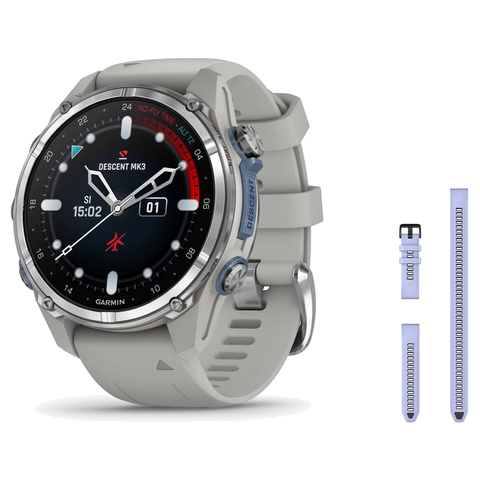
Garmin Descent Mk3 – 43 mm, Stainless Steel with Fog Gray Silicone Band
In stock — ships from Irvine, CA
This item is currently on backorder. Order now to reserve yours, and we will ship it as soon as it is back in stock.
Garmin Descent Mk3 – 43 mm, Stainless Steel with Fog Gray Silicone Band is backordered and will ship as soon as it is back in stock.
Pickup currently unavailable at In Store
Warranty
Warranty
Click logo for additional details


-
DiveCatalog Moldable Mouthpiece w/ installation for Regulators
$34.95$3.50
1 -
DiveCatalog.com Upside Down Drysuit Hanger w/ Regulator and Accessory Hooks
$29.95$3.00
1 -
DiveCatalog.com Universal Dive Gear Hanger with Accessory Arms fits Wetsuits, Drysuits, BCDs, Backpacks
$29.95$3.00
1 -
DiveCatalog.com Small Retractor
$24.95$2.50
1 -
DiveCatalog.com Heavy Duty Wetsuit and Drysuit Hanger with Extra Wide Shoulder Saver
$22.95$2.30
1


-
DiveCatalog.com Quick Dry Multi Accessory Dive Gear Hanger for Boots, Gloves, Hood
$22.95$2.30
1 -
DiveCatalog Scuba Essentials - Wetsuit Hanger for Scuba Diving, Snorkeling, and Surfing
$19.95$2.00
1 -
DiveCatalog Essentials - BCD and Regulator Hanger for Scuba Diving
$19.95$2.00
1 -
DiveCatalog.com Underwater Pointer Tool
$18.95$1.90
1 -
DiveCatalog Anti-Fatigue Soft Bite Regulator and Octo Mouthpiece
$17.95$1.80
1 -
DiveCatalog.com Basic Black Silicone Snorkel
$14.95$1.50
1 -
DiveCatalog.com Regulator Necklace
$11.95$1.20
1 -
DiveCatalog.com Water Activated LED Signal Light - Green
$11.95$1.20
1 -
DiveCatalog.com Dry Box with Lanyard
$9.95$1.00
1 -
DiveCatalog x Stream2Sea Mask Defog, Flip Cap Bottle, 2 oz
$9.95$1.00
1 -
DiveCatalog x Stream2Sea Mask Defog Spray, 2 oz
$9.95$1.00
1 -
DiveCatalog.com Fin Holder
$7.95$0.80
1 -
Nocturnal Lights Buoyancy / Protective Sleeve for SLX 800XI
$24.99$2.50
1 -
Nocturnal Lights Buoyancy & Protective Sleeve for the SLX Underwater LED Lights
$19.99$2.00
1 -
Nocturnal Lights Large Hand Mount with 1.75-2 Light Slot HM.LG
$19.99$2.00
1 -
Nocturnal Lights Medium Hand Mount with 1.385-1.625 Light Slot HM.MED
$19.99$2.00
1 -
Nocturnal Lights Small Universal Hand Mount with Two 1-1.25 Slots HM.SM
$19.99$2.00
1 -
Nocturnal Lights 2 YS Flex Arm Extra Short FLEXARM.YS2
$15.99$1.60
1 -
Nocturnal Lights 7 Ultra Slim Underwater Camera Tray TRAY.SLIM5
$3.99$0.40
1


Payment & Security
Payment methods
Your payment information is processed securely. We do not store credit card details nor have access to your credit card information.
Save with a package
Ready-made packages that include this item
Product Information
Garmin Descent Mk3 to 43 mm is a watch-style dive computer with a stainless steel bezel and fog gray silicone band, rated to 20 ATM (200 meters) and built to comply with EN 13319. It runs seven dive modes, including Single-Gas, Multi-Gas, CCR, Gauge, Apnea, Apnea Hunt, and Multisport, inside a 43 mm case sized for smaller wrists.
Who it is for
This computer suits divers who want one device for diving, daily wear, and multisport training. The 43 mm case and QuickFit 20 mm band compatibility make it an option for divers with smaller wrists who still want full Multi-Gas and CCR dive support alongside smartwatch features.
Key details
- Water rating: 20 ATM Dive, compliant with EN 13319
- Depth sensor accurate from 0 m to 200 m, with 0.1 m resolution until 99.9 m and 1 m resolution at 100 m
- Decompression model: Bühlmann ZHL-16C
- Battery: rechargeable built-in lithium-ion, up to 30 hours in Dive mode (Always On Display) and up to 10 days in Smartwatch mode with Wrist Gesture (4 days with Always On Display)
- Display: 1.2 inch AMOLED, 390 x 390 pixels, sapphire lens
- Case: fiber-reinforced polymer with stainless steel rear cover and stainless steel bezel, leakproof metal inductive buttons
- Multi-Gas mode sets oxygen content from 5 to 100 percent, with one bottom gas plus up to 11 additional decompression or backup gases
- CCR mode supports configurable PO2 setpoints, CC diluent gases, and OC decompression/backup gases
- Built-in 3-axis compass with automatic calibration
Compatibility and sizing
The case measures 43 x 43 x 14.15 mm and weighs 53.5 g without a band or 72.5 g with the silicone band. The silicone band fits wrists from 128 mm to 224 mm, and an extra-long silicone band fits 128 mm to 360 mm; the watch accepts QuickFit 20 mm bands. It pairs with the Garmin Dive app on a compatible smartphone and with inReach devices for satellite messaging.
DiveCatalog.com is an authorized Garmin dealer and a dive shop in Irvine, California, open since 2003. Call 888-701-4017 or chat with us if you have questions about fit or compatibility before you buy.
- Seven dive modes: Single-Gas, Multi-Gas, CCR, Gauge, Apnea, Apnea Hunt, and Multisport are built into the Descent Mk3.
- Multi-Gas flexibility: Set oxygen content from 5 to 100 percent, with one bottom gas plus up to 11 additional decompression or backup gases.
- CCR support: Configurable PO2 setpoints, CC diluent gases, and OC decompression/backup gases for closed-circuit rebreather diving.
- Dive-focused design: 1.2 inch AMOLED color display, sapphire lens, 200-meter dive-rated case, and leakproof metal inductive buttons.
- Long battery life: Up to 30 hours in Dive mode and up to 10 days in Smartwatch mode.
- Dive log sync: Automatically syncs with the Garmin Dive app on a compatible smartphone to share data, track gear, and add photos or notes.
- Diveview maps: Color bathymetric depth contours and more than 4,000 dive sites shown on the wrist.
- Built-in compass: 3-axis electronic compass with automatic calibration for underwater navigation.
- Lume mode: Green luminescence powered by an ambient light sensor for low-light readability.
- InReach compatible: Pairs with Garmin inReach devices for satellite messaging off-grid.
- Customizable dive screens: Add extra screens to each dive mode with the data fields you want to see.
| Water rating | 20 ATM Dive (EN 13319) |
| Decompression model | Bühlmann ZHL-16C |
| Depth sensor accuracy | 0 m to 200 m (0 ft to 656 ft) |
| Depth sensor resolution | 0.1 m until 99.9 m, 1 m at 100 m; 1 ft |
| Battery type | Rechargeable, built-in lithium-ion |
| Battery life, Dive mode | Up to 30 hours (Always On Display) |
| Battery life, Smartwatch mode | Up to 10 days with Wrist Gesture; up to 4 days with Always On Display |
| Operating/storage temperature | -20 to 45 C (-4 to 113 F) |
| Underwater operating temperature | 0 to 40 C (32 to 104 F) |
| Display | 1.2 in (30.4 mm) AMOLED, 390 x 390 pixels |
| Lens material | Sapphire crystal |
| Bezel material | Stainless steel |
| Case material | Fiber-reinforced polymer with stainless steel rear cover |
| Strap material | Silicone |
| Physical size | 43 x 43 x 14.15 mm |
| Weight | No band: 53.5 g; with silicone band: 72.5 g |
| Band compatibility | QuickFit 20 mm |
| Wrist fit, silicone band | 128 to 224 mm |
| Wrist fit, extra-long silicone band | 128 to 360 mm |
| Memory/history | 32 GB |
| Connectivity | Bluetooth, ANT+, Wi-Fi, Subwave |
| Certification | EN 13319 |
- Carbon Gray DLC Titanium with Black Band
- Descent Mk3i – 51 mm, carbon gray DLC titanium with black silicone band
- Black extra-long adjustment strap
- USB-C clip charging/data cable
- Documentation
- Carbon Gray DLC Titanium with DLC Titanium Band
- Descent Mk3i – 51 mm, carbon gray DLC titanium with DLC titanium band
- Black QuickFit™ 26 silicone band
- Black extra-long adjustment strap
- USB-C clip charging/data cable
- Documentation
- Descent Mk3i – 51 mm Bundle
- Descent Mk3i – 51 mm, carbon gray DLC titanium with black silicone band
- Descent T2 transmitter
- Black extra-long adjustment strap
- USB-C clip charging/data cable
- Air spool
- Documentation
⚠️ WARNING: This product contains chemicals known to the State of California to cause cancer, birth defects, or other reproductive harm. For more information, visit www.P65Warnings.ca.gov.
Frequently Asked Questions
Why do I need my own dive computer?
A dive computer tracks the actual depth and time profile you have dived and the tissue loading that follows from it, which is personal to you. A rented computer has no record of your recent diving, and swapping models each trip means relearning the display and menus when you should be focused on the dive. Owning one you know well is a genuine safety and comfort improvement.
Can two divers share one dive computer?
No. A computer only tracks the profile of the diver actually wearing it, and even buddies who stay together do not follow identical depth and time profiles. Every diver needs their own computer, and passing one between divers or between dives is unsafe.
What does conservatism mean on a dive computer?
Conservatism settings make the computer's calculations more cautious, shortening allowed bottom times and adding margin beyond the base algorithm. Divers commonly add conservatism for factors such as cold, hard work, fatigue, or repetitive multi-day diving. How and when to adjust it is covered by your training and your computer's manual, so set it before you get in the water and follow what your computer tells you during the dive.
What kind of battery does a dive computer use?
Broadly there are two types: user-replaceable batteries, often a coin cell that you or a shop swap along with resealing an o-ring, and sealed rechargeable batteries that charge from a cable or dock. Neither is universally better, as replaceable cells are convenient on remote trips while rechargeables avoid ever opening the case. Follow the manual exactly for any battery change, because an improperly seated o-ring or case is the usual cause of a flooded computer.
Do I need to do anything special for altitude diving or flying after diving?
Yes, both change the picture, and both are governed by your training agency's guidance and your computer's instructions rather than any casual rule of thumb. Many computers have an altitude setting that must be configured before diving at elevation, and most display a no-fly or surface-interval countdown after a dive. Follow your computer and your training, and ask a dive professional or a dive-medicine specialist if you are unsure.
How do I care for a dive computer?
Rinse it in fresh water after every dive day, paying attention to the buttons and around any sensor openings where salt crystals form, and let it dry fully before storing. Keep it out of prolonged direct sun and extreme heat, and avoid pressing buttons while sand is on the case. Inspect the strap or bungee often, because a failed strap loses far more computers than a failed computer does.
What is the difference between wrist, console, and air-integrated dive computers?
A wrist computer is worn like a watch and read by raising your arm, while a console computer sits at the end of a hose with your other gauges. Air integration means the computer also displays cylinder pressure, either through a hose or from a wireless transmitter on the first stage, and often estimates remaining gas time. All of them run a decompression algorithm, so the real difference is where you read the information and how much of it you get.
What is the battery life of the Garmin Descent Mk3 43mm in Dive mode?
The Descent Mk3 43mm runs up to 30 hours in Dive mode with Always On Display active. In Smartwatch mode it lasts up to 10 days with Wrist Gesture, or up to 4 days with Always On Display enabled. It uses a rechargeable, built-in lithium-ion battery.
What wrist sizes fit the Garmin Descent Mk3 43mm?
The included silicone band fits wrists from 128 mm to 224 mm, and an extra-long silicone band option fits 128 mm to 360 mm. The watch case measures 43 x 43 x 14.15 mm and accepts QuickFit 20 mm bands for swapping straps.
Which dive modes does the Garmin Descent Mk3 43mm support?
It supports seven dive modes: Single-Gas, Multi-Gas, CCR (closed-circuit rebreather), Gauge, Apnea, Apnea Hunt, and Multisport. Multi-Gas mode allows oxygen settings from 5 to 100 percent with one bottom gas plus up to 11 additional decompression or backup gases, and CCR mode supports configurable PO2 setpoints and CC diluent gases.
Does the Garmin Descent Mk3 43mm connect to a smartphone app?
Yes, it pairs with the Garmin Dive app on a compatible smartphone to automatically sync dive logs, and it is also compatible with Garmin inReach devices for satellite messaging. Dive data, photos, and notes can be reviewed and shared through the app after a dive.