


Dive Rite TransPac Harness Nylon Backplate Compatible With Wings
In stock — ships from Irvine, CA
This item is currently on backorder. Order now to reserve yours, and we will ship it as soon as it is back in stock.
Dive Rite TransPac Harness Nylon Backplate Compatible With Wings - S (Small) is backordered and will ship as soon as it is back in stock.
Pickup available at In Store
Usually ready in 2 hours
Dive Rite TransPac harness sizing. Imperial in bold, metric underneath.
Short backplate
| Size | Step 2 measurement in · cm |
|---|---|
| S |
<26 <66 |
| M |
25–29 64–74 |
| L-SHORT |
27–31 69–79 |
| XL-SHORT |
29–33 74–84 |
Standard backplate
| Size | Step 2 measurement in · cm |
|---|---|
| L |
29–33 74–84 |
| XL |
31–35 79–89 |
| 2XL |
>34 >86 |
How Dive Rite measures
- Step 1: Determine whether you need a short or standard backplate. A. Measure from the small of the back up to the base of the neck. B. Use your measurement to determine which backplate you need. <19″ (48CM) = SHORT BACKPLATE. >19″ (48CM) = STANDARD BACKPLATE.
- Step 2: Determine the correct size. A. Measure from the small of the back (where you want your waist belt to ride), over the shoulder, to 1in (2.5cm) above the nipple line for men, or the bust line for women (this will be the termination point of the shoulder pad). B. Use this measurement to determine the correct size on the charts below. Use the chart that corresponds to the backplate size you determined in step 1.
From Dive Rite’s chart: Every size has a range of adjustability. Transpacs are shipped adjusted to approximately the center of these ranges and can be shortened or lengthened to accommodate anyone within the range. There is some overlap of the ranges. If you fall towards the edge of one size range, it is recommended to go up or down a size so that you are closer to the center of the range to allow for more adjustability.
Source: Dive Rite’s size chart.


-
DiveCatalog.com Quick Dry Multi Accessory Dive Gear Hanger for Boots, Gloves, Hood
$22.95$2.30
-
Nocturnal Lights Ball Joint Adapter for Underwater Ball Joint Arm Strobe and Lighting Systems
$19.99$2.00
-
Nocturnal Lights Buoyancy & Protective Sleeve for the SLX Underwater LED Lights
$19.99$2.00
-
Nocturnal Lights YS Arm Adapter for M700 Lights ADP.M7YS
$19.99$2.00
-
Nocturnal Lights Large Hand Mount with 1.75-2 Light Slot HM.LG
$19.99$2.00


-
Nocturnal Lights Medium Hand Mount with 1.385-1.625 Light Slot HM.MED
$19.99$2.00
-
Nocturnal Lights Small Universal Hand Mount with Two 1-1.25 Slots HM.SM
$19.99$2.00
-
DiveCatalog DIN Cap for 1st Stage (Female) for Scuba Diving Tanks - Scuba Essentials
$19.95$2.00
-
DiveCatalog Comfo-Bite Silicone Mouthpiece for Scuba Diving Regulators Black
$19.95$2.00
-
DiveCatalog Essentials - BCD and Regulator Hanger for Scuba Diving
$19.95$2.00
-
DiveCatalog Scuba Essentials - Wetsuit Hanger for Scuba Diving, Snorkeling, and Surfing
$19.95$2.00
-
Nocturnal Lights 45 Degree Ball Joint Adapter with T-base Slot BJADAPTER.TBASE45
$18.99$1.90
-
DiveCatalog.com Underwater Pointer Tool
$18.95$1.90
-
DiveCatalog Hose Clamp for Scuba Diving - Scuba Essentials
$17.95$1.80
-
DiveCatalog Neoprene Mask Strap Cover
$17.00$1.70
-
Nocturnal Lights 90 Degree Ball Joint Adapter with T-base Slot BJADAPTER.TBASE90
$15.99$1.60
-
Nocturnal Lights 2 YS Flex Arm Extra Short FLEXARM.YS2
$15.99$1.60
-
DiveCatalog.com Basic Black Silicone Snorkel
$14.95$1.50
-
DiveCatalog Silicone Scuba Octopus Mouthpiece with Color Tab & Regulator Tie – Comfortable, Leak-Free Dual Color
$14.95$1.50
-
DiveCatalog Silicone Mouthpiece Replacement w/ installation - Scuba Essentials
$14.95$1.50
-
DiveCatalog Rubber Tank Valve Protector for Scuba Diving Tanks - Scuba Essentials
$11.95$1.20
-
DiveCatalog.com Regulator Necklace
$11.95$1.20
-
DiveCatalog.com Water Activated LED Signal Light - Green
$11.95$1.20
-
DiveCatalog x Stream2Sea Mask Defog, Flip Cap Bottle, 2 oz
$9.95$1.00
-
DiveCatalog Fin Strap and Scuba Dive Accessory Holder Scuba Accessory Essentials
$9.95$1.00
-
DiveCatalog.com Dry Box with Lanyard
$9.95$1.00
-
DiveCatalog x Stream2Sea Mask Defog Spray, 2 oz
$9.95$1.00
-
DiveCatalog Female Quick Release Clip with Bungee cord for Scuba Accessory Essentials
$8.99$0.90
-
DiveCatalog.com Fin Holder
$7.95$0.80
-
DiveCatalog.com Scuba Mouthpiece Cover
$7.95$0.80
-
Multi-Purpose Clip with Male and Female Quick Release Clip and Bungee Cord Scuba Accessory Essentials by DiveCatalog
$5.95$0.60
-
DiveCatalog Scuba Essentials - PVC Tank Valve Protector for Scuba Diving Tanks
$5.95$0.60
-
Whistle with Lanyard in Orange by DiveCatalog
$5.00$0.50
-
Nocturnal Lights 7 Ultra Slim Underwater Camera Tray TRAY.SLIM5
$3.99$0.40
-
DiveCatalog.com Stainless Steel 2 Inch Webbing Keeper with Serrated Teeth Weights
$1.95$0.20
-
DiveCatalog.com Weight Keeper Stopper - Black
$1.45$0.15


Payment & Security
Payment methods
Your payment information is processed securely. We do not store credit card details nor have access to your credit card information.
Save with a package
Ready-made packages that include this item
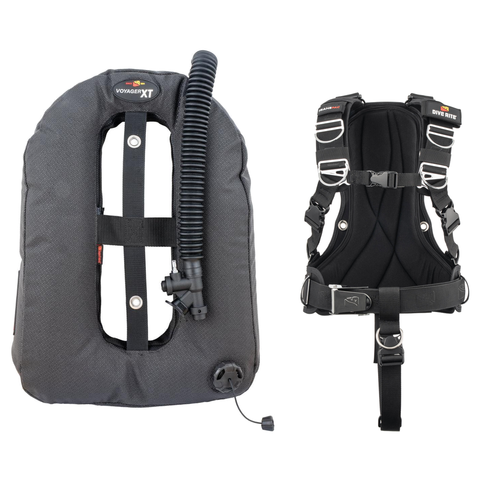
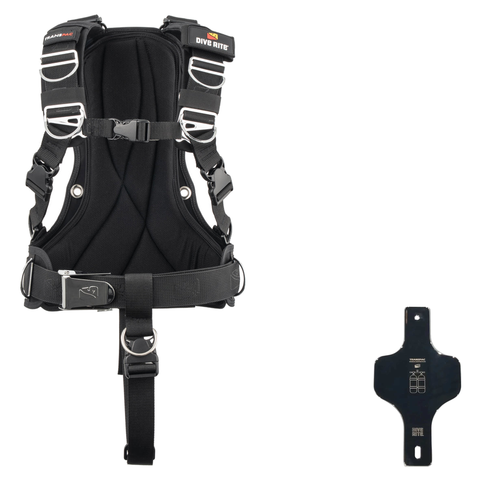
Product Information
The TransPac harness by Dive Rite is a modular harness designed for single-tank, backmounted doubles, sidemount, and rebreather configurations. Constructed with a 1000 denier nylon backplate, 2 in webbing, and marine-grade stainless steel hardware, it balances rugged durability with comfort for long hikes and cave dives. Sizes range from Small to XXL, including short options, and the harness accepts any Dive Rite wing and common accessories such as weight pockets and D-rings.
- 1000 denier nylon backplate and reinforced 2 in (50 mm) webbing for durability and load support
- Laser-cut marine-grade stainless steel and black hard-coat anodized aluminum hardware for corrosion resistance
- Compatible with single tank, backmounted doubles, sidemount, and rebreather setups
- Quick-release acetal resin buckles, crotch strap, and multiple 2 in D-rings for accessories and trim weights
- Available sizes Small–XXL, including Large Short and XL Short options
| Material | 1000 denier nylon backplate, acetal resin quick-release buckles |
| Webbing Size | 2 in (50 mm), rated 7,000 lb breaking strength |
| Hardware | Laser-cut marine-grade stainless steel and black hard-coat anodized aluminum |
| Weight | 4.25–5 lb depending on size |
| D-Rings | 2 in (50 mm) stainless steel D-rings for attachment points |
| Cam Strap Dimensions | 2 x 36 inches (91.4 cm) |
| Crotch Strap Size | 1.5 inches (3.8 cm) |
| Compatibility | Accepts any Dive Rite wing, configurable for single tank, doubles, sidemount, or rebreather |
⚠️ WARNING: This product contains chemicals known to the State of California to cause cancer, birth defects, or other reproductive harm. For more information, visit www.P65Warnings.ca.gov.
Frequently Asked Questions
How should a scuba BCD fit?
A BCD should fit snugly enough that it does not ride up toward your ears when inflated, while still letting you breathe fully. Fasten the waist and cummerbund first, then adjust the shoulder straps so the tank sits close to your back and the shoulders cannot slide off. With the BCD fully inflated at the surface you should still be able to take a deep, comfortable breath; if it squeezes your chest, loosen it or move up a size.
How do I rinse and care for a BCD after diving?
Rinse the outside in fresh water and also flush the inside of the bladder, because salt water gets in through the inflator and dump valves. Fill the bladder roughly a third full of fresh water through the oral inflator, slosh it around, then drain it out through the inflator and each dump valve. Hang it to dry out of direct sunlight and store it partially inflated so the bladder walls do not stick together.
Should I use integrated weights or a weight belt?
Integrated weight pockets carry the lead in the BCD itself, which many divers find more comfortable and easier on the hips, while a weight belt keeps the weight independent of your BCD. Either way, you must be able to release your ditchable weight quickly with one hand, and your buddy should know how your system releases. Non-ditchable trim pockets are useful for balance but should never hold weight you might need to drop.
How do I pack a BCD for travel?
Make sure the BCD is completely dry inside and out before packing so it does not mildew in transit. Remove all weights, deflate it fully, and fold or roll it around softer items such as a wetsuit to cushion the inflator and valves. Avoid hard creases in the air cell, and unpack and air it out as soon as you arrive.
When does a BCD need to be serviced?
Follow the service interval in the manufacturer's manual, which is commonly an annual inspection alongside the rest of your life-support gear. Have the inflator, dump valves, and bladder checked any time the inflator sticks, free-flows, feels rough, or the BCD holds air poorly. Between services, confirm that it inflates and deflates properly as part of every pre-dive check.
What is the difference between a jacket-style and a back-inflate BCD?
A jacket-style BCD holds air in panels that wrap around your sides as well as your back, while a back-inflate BCD keeps the entire air cell behind you. Jacket styles tend to feel very stable and upright at the surface, and back-inflate styles keep the chest clear and are often preferred for horizontal trim underwater. Neither is objectively better, so treat it as a fit and preference decision and try both if you can.
Will my BCD fit any scuba tank?
Most recreational BCDs use an adjustable cam band sized for common single-cylinder diameters, so standard aluminum and steel tanks generally work. Re-check the band tension after the first wetting, because webbing can relax slightly and let the tank shift. If you dive doubles or unusual cylinder diameters, confirm compatibility with the manufacturer before assuming it will hold.
