


Scubapro MK19 EVO/G260
In stock — ships from Irvine, CA
This item is currently on backorder. Order now to reserve yours, and we will ship it as soon as it is back in stock.
Scubapro MK19 EVO/G260 - YOKE is backordered and will ship as soon as it is back in stock.
Pickup available at In Store
Usually ready in 2 hours


-
DiveCatalog.com Silicone Frameless Dive Mask
$59.95$6.00
1 -
DiveCatalog.com Retro Oval Dive Mask Without Nose Pocket Compensator
$44.95$4.50
1 -
DiveCatalog.com Classic Oval Dive Mask Silicone
$44.95$4.50
1 -
DiveCatalog.com Metal Coil Lanyard with Snap Clips
$39.95$4.00
1 -
DiveCatalog.com Junior Rubber Oval Dive Mask (15% smaller)
$34.95$3.50
1


-
DiveCatalog.com Compact Dive Knife
$34.95$3.50
1 -
DiveCatalog.com Auto Lock Retractor 90cm - Black
$34.95$3.50
1 -
DiveCatalog.com Dive Retractor
$34.95$3.50
1 -
DiveCatalog Dive Essentials - Auto-Rebound Style Retractor
$39.95$4.00
1 -
DiveCatalog Quick Release Coil Lanyard with Buckle Scuba Essentials
$29.95$3.00
1 -
DiveCatalog.com Air Gun - Blue
$27.95$2.80
1 -
DiveCatalog.com Folding Dive Knife
$32.95$3.30
1 -
DiveCatalog.com Diving Double Layer Slate Palm Size (5x7.25") with Pencil
$26.95$2.70
1 -
DiveCatalog.com Line Cutter
$24.95$2.50
1 -
DiveCatalog.com Semi-Dry Snorkel
$23.95$2.40
1 -
DiveCatalog.com Nylon Weight Belt
$22.95$2.30
1 -
DiveCatalog.com Finger Reel with Bolt Snap
$26.95$2.70
1 -
Nocturnal Lights Adjustable Goodman Handle with 1 / 4 Mounting Points HM.GM
$47.99$4.80
1 -
Nocturnal Lights Triple Ball Joint Clamp standard 1 balls BJCLAMP.TRIPLE
$27.99$2.80
1 -
Nocturnal Lights Ball Joint Clamp fits all standard 1 balls BJCLAMP.DOUBLE
$23.99$2.40
1 -
Nocturnal Lights T-base Connector for Ikelite quick release handles TBASE.IKEQR
$23.99$2.40
1 -
Nocturnal Lights YS Arm Adapter for M700 Lights ADP.M7YS
$19.99$2.00
1 -
Nocturnal Lights Ball Joint Adapter for Underwater Ball Joint Arm Strobe and Lighting Systems
$19.99$2.00
1 -
Nocturnal Lights 45 Degree Ball Joint Adapter with T-base Slot BJADAPTER.TBASE45
$18.99$1.90
1 -
Nocturnal Lights 90 Degree Ball Joint Adapter with T-base Slot BJADAPTER.TBASE90
$15.99$1.60
1


Payment & Security
Payment methods
Your payment information is processed securely. We do not store credit card details nor have access to your credit card information.
Save with Open Box or Used Purchase

Save with a package
Ready-made packages that include this item

Product Information
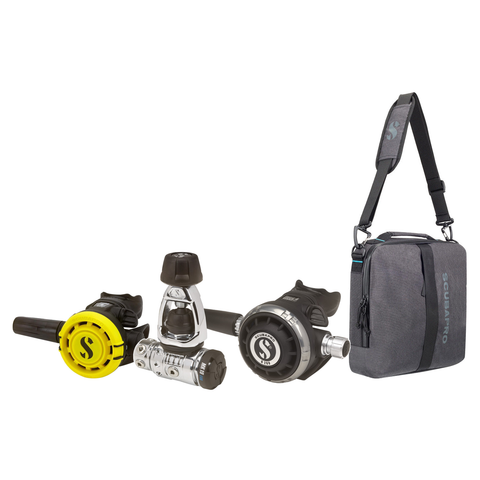
The Scubapro MK19 EVO/G260 is a complete first and second stage regulator system built for deep, cold and contaminated water diving, pairing an environmentally sealed air-balanced diaphragm first stage with a metal-component G260 second stage. It ships in the INT (yoke) configuration, is rated for Nitrox mixes up to 40% and weighs 2.8 lbs.
Who it is for
This system suits recreational divers who want cold water capability, as well as tech divers and cave explorers who need a regulator that keeps working in silt, pollutants and low temperatures. The MK19 EVO first stage is completely sealed off from the elements with a double spring dry chamber, so water and pollutants cannot foul the internals. The G260 second stage uses a reversible left-right hose attachment so it can be configured for technical diving layouts.
Key details
- First stage: diaphragm, air-balanced, chrome-plated brass with a dry ambient chamber.
- Ports: 2 opposing HP ports and 5 LP ports (4 standard plus 1 axial super high-flow).
- Second stage: G Series, air-balanced valve, metal internal components, anodized aluminum front and reinforced technopolymer casing.
- Controls: diver-adjustable inhalation effort knob and Venturi-Initiated Vacuum Assist (VIVA) dive/pre-dive switch.
- Breathing: high-flow exhaust valve and super-flow hose with oversized bore.
- Gas and connector: Nitrox up to 40%, INT (yoke) connector.
- Size and weight: 9.06 in. L x 7.09 in. W x 3.15 in. H, 2.8 lbs.
What's in the box
- MK19 EVO/G260 regulator system
- 4mm Allen key
- Product manual
DiveCatalog.com is an authorized Scubapro dealer and a real dive shop in Irvine, California since 2003. Call us at 888-701-4017 or start a chat if you have questions about hose routing, port layout or configuring this system for your setup.
- Environmentally sealed first stage keeps water, silt and pollutants out of the internals for cold and contaminated water diving.
- Air-balanced diaphragm first stage in chrome-plated brass delivers consistent breathing as depth and tank pressure change.
- Double spring dry chamber design keeps the ambient chamber sealed against water and pollutants.
- Air-balanced G260 second stage uses metal internal components for smooth, stable performance.
- Diver-adjustable inhalation effort knob lets you fine-tune breathing resistance in the water.
- Venturi-Initiated Vacuum Assist (VIVA) dive/pre-dive switch controls free-flow tendency at the surface.
- High-flow exhaust valve clears exhaled gas quickly and reduces breathing effort.
- Super-flow hose with oversized bore increases gas delivery to the second stage.
- Reversible left-right hose attachment supports technical diving hose routing on either side.
- Port layout includes 2 opposing HP ports and 5 LP ports, one of them an axial super high-flow port.
- Reinforced technopolymer casing with anodized aluminum front cover for durability.
- Nitrox ready to 40% with an INT (yoke) connector and a 2.8 lb system weight.
| 1st Stage Type | Diaphragm, air-balanced |
| 1st Stage Materials | Chrome-plated brass with dry ambient chamber |
| 2nd Stage Series | G Series (G260) |
| 2nd Stage Design | Balanced |
| 2nd Stage Materials | Anodized aluminum front, metal internal components, reinforced technopolymer casing |
| Connector Type | INT (yoke) |
| HP Ports | 2 (opposing) |
| LP Ports | 5 (4 standard plus 1 axial super high-flow) |
| Adjustable | Yes, inhalation effort knob |
| Venturi Control | VIVA dive/pre-dive switch |
| Environmental Sealing | Sealed, double spring dry chamber |
| Hose Attachment | Reversible left-right |
| Water Temperature | Cold |
| Nitrox Mix | Up to 40% |
| Weight | 2.8 lbs |
| Dimensions | 9.06 in. L x 7.09 in. W x 3.15 in. H |
| MPN | 12.255.010 |
| Warranty | Scubapro limited lifetime warranty on regulators |
- MK19 EVO/G260 regulator system
- 4mm Allen key
- Product manual
⚠️ WARNING: This product contains chemicals known to the State of California to cause cancer, birth defects, or other reproductive harm. For more information, visit www.P65Warnings.ca.gov.
Frequently Asked Questions
Should I order my ScubaPro regulator in DIN or yoke?
Yoke (INT) is the most common fitting on rental tanks in North America and the Caribbean, so it is the simplest choice if you mostly dive at resorts. DIN screws directly into the tank valve, is rated for higher pressures, and is standard in Europe and technical diving — and a DIN regulator can use a simple adapter on yoke tanks, which makes DIN the more flexible long-term choice for traveling divers. ScubaPro sells both versions, and a yoke regulator can later be converted to DIN by an authorized dealer using a genuine ScubaPro conversion kit (DIN owners going the other way simply use a DIN-to-yoke adapter — no conversion needed).
How often does a ScubaPro regulator need service?
ScubaPro's official recommendation is a full service by an authorized ScubaPro technician every 2 years or 100 dives, whichever comes first. If you dive heavily (100+ dives a year), ScubaPro recommends an inspection every 6 months and an overhaul annually. Staying on schedule also keeps you eligible for ScubaPro's Parts For Life program — free service parts for the original owner when the regulator is registered and purchased as part of a qualifying package from an authorized dealer. As an authorized ScubaPro dealer, we can help with registration and service when it is due.
How often does a scuba regulator need servicing?
Follow the interval in your regulator's manual, since manufacturers commonly specify an annual inspection or a set number of dives and many warranties depend on it. A regulator is life-support equipment, so service belongs with a factory-trained technician rather than being attempted at home. Have it looked at sooner than scheduled if you notice increased breathing effort, free-flow, bubbles, or water in the second stage.
How do I rinse and care for a regulator after diving?
Make sure the dust cap is dry and firmly seated over the first-stage inlet before the regulator goes anywhere near water, because water inside the first stage is the leading cause of internal corrosion. Rinse in fresh water without pressing the purge button, since purging while depressurized can draw water back into the second stage. Shake out the water and hang it to dry with the hoses in wide, gentle loops rather than tight bends.
Can I fly with a scuba regulator?
Regulators travel well and are usually best carried in hand luggage where they will not be crushed or lost. A regulator holds no gas of its own, so there is nothing inherently problematic about it on an aircraft, though the airline and security screeners always have the final say. Pack it dry with the dust cap in place, in a padded regulator bag or wrapped in soft gear.
Can I use my regulator with nitrox?
Many modern regulators are supplied as suitable for nitrox mixes up to 40 percent oxygen, which is the widely used recreational industry standard, while anything above that requires dedicated oxygen-clean equipment and procedures. Confirm what your specific regulator's manual states, and follow your nitrox training and your fill station's requirements. Never assume a regulator is oxygen-service clean simply because it looks clean or is new.
What is the difference between DIN and yoke regulators?
A yoke (A-clamp) fitting clamps over the tank valve and is the most common connection across much of the recreational world, while a DIN fitting screws into the valve and is standard in much of Europe and in technical diving. DIN captures the o-ring inside the threads, which many divers consider more secure, but yoke is often what rental cylinders provide. Adapters exist in both directions, so check what is used where you dive before deciding.
What is the octopus regulator for?
The octopus is your backup second stage, carried so you can share air with a buddy who is out of gas, or breathe from it yourself if your primary fails or free-flows. It is normally on a longer, brightly colored hose so it is easy to find and hand over under stress. Secure it in the triangle between your chin and the bottom of your rib cage so it is instantly accessible and not dragging through sand or coral.
How should I store a regulator between dive trips?
Store it fully dry, out of sunlight, with the dust cap in place and the hoses in wide loops rather than tightly coiled. Avoid hanging it by the second stages for long periods, which stresses the hose fittings; laying it flat in a padded bag or hanging it by the first stage is kinder. If it has sat unused for a long stretch, have it checked before your next trip rather than assuming it is ready to dive.
What comes with the Scubapro MK19 EVO/G260?
The package includes the MK19 EVO/G260 regulator system, a 4mm Allen key and the product manual. The system covers the MK19 EVO first stage, the G260 second stage and the super-flow hose that connects them. An octopus, a submersible pressure gauge and a dive computer are not part of this package, so plan to add a backup second stage and instrumentation separately.
Is the MK19 EVO/G260 suitable for cold water diving?
Yes. The MK19 EVO first stage is completely sealed off from the elements and uses a double spring dry chamber, so water and pollutants cannot reach the internal moving parts. The G260 second stage adds metal internal components and a high-flow exhaust valve. Scubapro rates the system for cold water, which is why it is used for deep, cold and contaminated water diving.
How many ports does the MK19 EVO first stage have?
The MK19 EVO first stage has 2 opposing high pressure ports and 5 low pressure ports. Four of the LP ports are standard and the fifth is an axial super high-flow port. The two opposing HP ports let you route high-pressure hoses from either side of the first stage.
Can the G260 second stage be set up for left-hand hose routing?
Yes. The G260 uses a reversible left-right hose attachment, so the hose can enter from either side of the second stage. That flexibility is intended for technical diving layouts where the primary routes over a specific shoulder.
Review summary
Reviewers consistently describe this combo as an effortless breather, with several saying it is the easiest-breathing regulator they have used. Divers report the same smooth delivery upside down, vertical, and horizontal, at the surface and down to 150 feet, and in water as cold as 43 degrees. One owner reports several hundred dives with no drop in performance, and the simple, rugged design draws repeated praise. Buyers of used units note servicing may not include a thorough cleaning. A solid pick for cold-water, deep, and high-use divers who want proven, no-fuss performance.
What reviewers like
Good to know
