-
DiveCatalog DIN Cap for 1st Stage (Female) for Scuba Diving Tanks - Scuba Essentials
$19.95$2.00
1 -
DiveCatalog Hose Clamp for Scuba Diving - Scuba Essentials
$17.95$1.80
1 -
DiveCatalog Neoprene Mask Strap Cover
$17.00$1.70
1 -
DiveCatalog Silicone Mouthpiece Replacement w/ installation - Scuba Essentials
$14.95$1.50
1 -
DiveCatalog Rubber Tank Valve Protector for Scuba Diving Tanks - Scuba Essentials
$11.95$1.20
1


-
DiveCatalog Fin Strap and Scuba Dive Accessory Holder Scuba Accessory Essentials
$9.95$1.00
1 -
DiveCatalog Female Quick Release Clip with Bungee cord for Scuba Accessory Essentials
$8.99$0.90
1 -
DiveCatalog.com Scuba Mouthpiece Cover
$7.95$0.80
1 -
Multi-Purpose Clip with Male and Female Quick Release Clip and Bungee Cord Scuba Accessory Essentials by DiveCatalog
$5.95$0.60
1 -
DiveCatalog Scuba Essentials - PVC Tank Valve Protector for Scuba Diving Tanks
$5.95$0.60
1 -
Whistle with Lanyard in Orange by DiveCatalog
$5.00$0.50
1 -
DiveCatalog.com Stainless Steel 2 Inch Webbing Keeper with Serrated Teeth Weights
$1.95$0.20
1 -
DiveCatalog.com Weight Keeper Stopper - Black
$1.45$0.15
1


Payment & Security
Payment methods
Your payment information is processed securely. We do not store credit card details nor have access to your credit card information.
Product Information
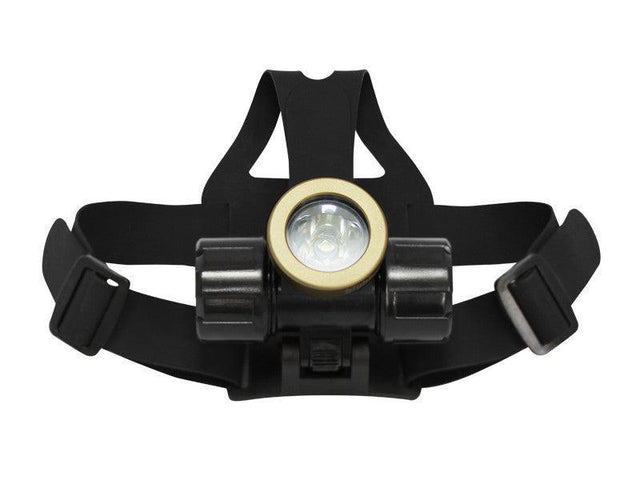
The BigBlue Head Light 450-Lumen Narrow Beam (HL450N) is a head-mounted dive light that outputs up to 450 lumens through an 8° narrow beam, powered by three AAA alkaline batteries and depth tested to 100 meters.
Who it is for
This light is built for divers who want a compact, head-worn light with a narrow, focused beam rather than a wide flood pattern. It runs on three AAA alkaline batteries, so it suits divers who prefer an easily replaceable power source over a rechargeable battery pack, and the adjustable head strap fits most head sizes.
Key details
- 450 lumens maximum output (Level IV), with 225 Lm, 113 Lm, and 45 Lm on Levels III, II, and I
- 8° beam angle from a Cree LED rated at 6500K color temperature
- Burn times of 2 hours (Level IV), 4 hours (Level III), 8 hours (Level II), and 20 hours (Level I)
- Powered by 3 x AAA alkaline batteries
- Depth tested to 100 meters (330 feet)
- Weighs 187g including batteries, with buoyancy of -56g
- Housing is anodized aluminum alloy (light head) and polycarbonate (body); size is 36.8mm diameter x 84.4mm length, with a 41mm light head diameter
What's in the box
- Light
- Head strap
- Two spare o-rings
- Silicone lube
- Owner's manual
- Manufacturer's 1-year warranty
DiveCatalog.com is an authorized BigBlue dealer and a dive shop in Irvine, California, open since 2003. Call 888-701-4017 or start a chat if you have questions about fit or compatibility before you order.
- 450-lumen maximum output across four power settings (45, 113, 225, and 450 lumens).
- 8° narrow beam angle from a Cree LED light source.
- 6500K color temperature for a cool white beam.
- Four power settings with burn times from 2 hours at full power to 20 hours at the lowest setting.
- Powered by 3 x AAA alkaline batteries for easy field replacement.
- Depth rated to 100 meters (330 feet) tested.
- Anodized aluminum alloy light head and polycarbonate body for the housing construction.
- Weighs 187g including batteries, with a buoyancy of -56g.
- Double o-ring waterproof sealing with two spare o-rings included.
- Adjustable head strap for mounting on the head.
- Manufacturer's 1-year warranty included.
| Lumens | 45 Lm (Level I), 113 Lm (Level II), 225 Lm (Level III), 450 Lm (Level IV) |
| Beam Angle | 8° |
| Burn Time | 2 hrs (level IV), 4 hrs (level III), 8 hrs (level II), 20 hrs (level I) |
| Light Source | Cree LED |
| Power Source | 3 x AAA alkaline batteries |
| Color Temperature | 6500K (Cool White) |
| Maximum Depth | 100 Meters Tested |
| Weight | 187g (including battery) |
| Buoyancy | -56g (including batteries) |
| Size | Dia. 36.8 x L. 84.4 mm (light head dia. 41mm) |
| Housing Material | Aluminum Alloy light head and Polycarbonate body |
| Warranty | Manufacturer's 1-year warranty |
- Light
- Head strap
- Two spare o-rings
- Silicone lube
- Owner's manual
- Manufacturer's 1-year warranty
⚠️ WARNING: This product contains chemicals known to the State of California to cause cancer, birth defects, or other reproductive harm. For more information, visit www.P65Warnings.ca.gov.
Frequently Asked Questions
What do lumens mean on a dive light?
Lumens measure the total light output, but they say nothing about how that light is shaped, so a tight narrow beam can look far brighter at distance than a higher-lumen wide beam. Beam angle, color temperature, and water clarity affect what you actually see as much as the lumen figure does. Use lumens to compare lights of a similar beam type rather than as a single score of quality.
What is the difference between a primary and a backup dive light?
A primary light is your main light, usually brighter, larger, and with a longer burn time, while a backup is a small, simple light carried in case the primary fails. Any dive where you need a light to exit safely, such as a night dive, calls for carrying at least one backup. Backups are chosen for reliability and simplicity rather than for maximum output.
How long will a dive light run on one charge?
Burn time and brightness trade directly against each other, so the same battery run at a lower power setting lasts substantially longer. Manufacturers usually quote burn time at each power level, and many lights automatically step down output as the battery drains or the head heats up. Treat quoted figures as fresh-battery, ideal-condition numbers and plan for more burn time than your dive actually needs.
How do I care for the o-rings on a dive light?
The o-rings sealing the battery compartment are what keep the light from flooding, so inspect them for grit, hair, and nicks every time you open it, and wipe the sealing surfaces clean. Lubricate lightly with the grease type the manufacturer specifies, using a thin film rather than a heavy coat, because excess grease attracts sand. Replace o-rings when they look flattened, cracked, or dry, and do not over-tighten the cap in the hope of sealing a bad o-ring.
Can I fly with dive light batteries?
Lithium batteries are subject to airline and regulatory limits that vary by cell chemistry, watt-hour rating, and whether the cells are installed or loose. As a general rule lithium cells travel in carry-on baggage rather than checked baggage, with terminals protected against short circuit, but you must confirm your airline's current policy and any local rules before you fly. Carrying the manufacturer's battery specification sheet helps if you are questioned at screening.
How should I store and maintain a dive light between trips?
Rinse it in fresh water after each dive day and work the switch while it is submerged so salt does not crystallize inside it, then dry it before opening. For storage, remove or charge the batteries as the manual directs, and leave the cap loose so the o-ring does not take a permanent set. Never store a light with corroded or leaking cells inside it.
Should I turn a dive light on before I get in the water?
Test it briefly as part of your pre-dive check, but do not leave a powerful light running in air, because many are designed to shed heat into the water and can overheat on the surface. Check the manual, as some lights have thermal protection that dims or shuts them down when they are dry. Testing before you gear up is far better than discovering a dead light at depth.
What beam angle does the BigBlue HL450N head light have?
The HL450N has an 8° narrow beam angle, which is a fixed setting rather than an adjustable one. This narrow angle concentrates the Cree LED's output at 6500K color temperature for a focused beam rather than a wide flood pattern.
How many power settings does the HL450N have and what are the burn times?
The HL450N has four power settings: Level I at 45 lumens with a 20-hour burn time, Level II at 113 lumens for 8 hours, Level III at 225 lumens for 4 hours, and Level IV at 450 lumens for 2 hours. Burn time drops as output increases.
What comes with the BigBlue HL450N head lamp?
The HL450N ships with the light, an adjustable head strap, two spare o-rings, silicone lube, an owner's manual, and a manufacturer's 1-year warranty. The spare o-rings and lube let you maintain the battery compartment seal between dives.
How deep is the BigBlue HL450N rated for?
The HL450N is depth tested to 100 meters (330 feet). It weighs 187g including its three AAA alkaline batteries and has a buoyancy of -56g.