


Garmin Descent X30 Scuba Diving Dive Computer
In stock — ships from Irvine, CA
This item is currently on backorder. Order now to reserve yours, and we will ship it as soon as it is back in stock.
Garmin Descent X30 Scuba Diving Dive Computer is backordered and will ship as soon as it is back in stock.
Pickup available at In Store
Usually ready in 2 hours


-
DiveCatalog.com Quick Dry Multi Accessory Dive Gear Hanger for Boots, Gloves, Hood
$22.95$2.30
-
Nocturnal Lights Ball Joint Adapter for Underwater Ball Joint Arm Strobe and Lighting Systems
$19.99$2.00
-
Nocturnal Lights Buoyancy & Protective Sleeve for the SLX Underwater LED Lights
$19.99$2.00
-
Nocturnal Lights YS Arm Adapter for M700 Lights ADP.M7YS
$19.99$2.00
-
Nocturnal Lights Large Hand Mount with 1.75-2 Light Slot HM.LG
$19.99$2.00


-
Nocturnal Lights Medium Hand Mount with 1.385-1.625 Light Slot HM.MED
$19.99$2.00
-
Nocturnal Lights Small Universal Hand Mount with Two 1-1.25 Slots HM.SM
$19.99$2.00
-
DiveCatalog DIN Cap for 1st Stage (Female) for Scuba Diving Tanks - Scuba Essentials
$19.95$2.00
-
DiveCatalog Comfo-Bite Silicone Mouthpiece for Scuba Diving Regulators Black
$19.95$2.00
-
DiveCatalog Essentials - BCD and Regulator Hanger for Scuba Diving
$19.95$2.00
-
DiveCatalog Scuba Essentials - Wetsuit Hanger for Scuba Diving, Snorkeling, and Surfing
$19.95$2.00
-
Nocturnal Lights 45 Degree Ball Joint Adapter with T-base Slot BJADAPTER.TBASE45
$18.99$1.90
-
DiveCatalog.com Underwater Pointer Tool
$18.95$1.90
-
DiveCatalog Hose Clamp for Scuba Diving - Scuba Essentials
$17.95$1.80
-
DiveCatalog Neoprene Mask Strap Cover
$17.00$1.70
-
Nocturnal Lights 90 Degree Ball Joint Adapter with T-base Slot BJADAPTER.TBASE90
$15.99$1.60
-
Nocturnal Lights 2 YS Flex Arm Extra Short FLEXARM.YS2
$15.99$1.60
-
DiveCatalog.com Basic Black Silicone Snorkel
$14.95$1.50
-
DiveCatalog Silicone Scuba Octopus Mouthpiece with Color Tab & Regulator Tie – Comfortable, Leak-Free Dual Color
$14.95$1.50
-
DiveCatalog Silicone Mouthpiece Replacement w/ installation - Scuba Essentials
$14.95$1.50
-
DiveCatalog Rubber Tank Valve Protector for Scuba Diving Tanks - Scuba Essentials
$11.95$1.20
-
DiveCatalog.com Regulator Necklace
$11.95$1.20
-
DiveCatalog.com Water Activated LED Signal Light - Green
$11.95$1.20
-
DiveCatalog x Stream2Sea Mask Defog, Flip Cap Bottle, 2 oz
$9.95$1.00
-
DiveCatalog Fin Strap and Scuba Dive Accessory Holder Scuba Accessory Essentials
$9.95$1.00
-
DiveCatalog.com Dry Box with Lanyard
$9.95$1.00
-
DiveCatalog x Stream2Sea Mask Defog Spray, 2 oz
$9.95$1.00
-
DiveCatalog Female Quick Release Clip with Bungee cord for Scuba Accessory Essentials
$8.99$0.90
-
DiveCatalog.com Fin Holder
$7.95$0.80
-
DiveCatalog.com Scuba Mouthpiece Cover
$7.95$0.80
-
Multi-Purpose Clip with Male and Female Quick Release Clip and Bungee Cord Scuba Accessory Essentials by DiveCatalog
$5.95$0.60
-
DiveCatalog Scuba Essentials - PVC Tank Valve Protector for Scuba Diving Tanks
$5.95$0.60
-
Whistle with Lanyard in Orange by DiveCatalog
$5.00$0.50
-
Nocturnal Lights 7 Ultra Slim Underwater Camera Tray TRAY.SLIM5
$3.99$0.40
-
DiveCatalog.com Stainless Steel 2 Inch Webbing Keeper with Serrated Teeth Weights
$1.95$0.20
-
DiveCatalog.com Weight Keeper Stopper - Black
$1.45$0.15


Payment & Security
Payment methods
Your payment information is processed securely. We do not store credit card details nor have access to your credit card information.
Save with a package
Ready-made packages that include this item
Product Information
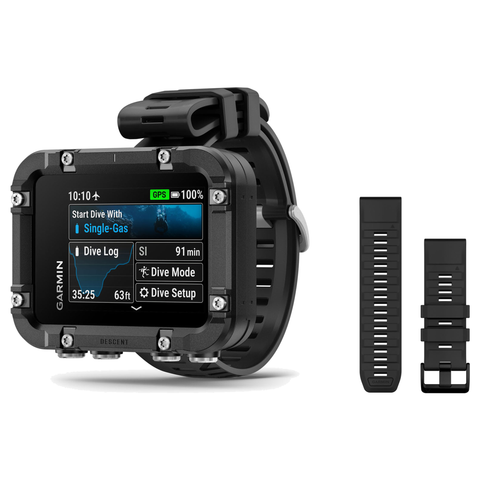
The Garmin Descent X30 Scuba Diving Dive Computer is a large-format, button-operated wrist dive computer with a 2.4-inch color display, built for recreational and entry-level technical divers who want big, readable data underwater. It supports single-gas, multi-gas and Trimix profiles on the Bühlmann ZHL-16C algorithm, is rated to 10 ATM (100 m) and runs up to 30 hours in dive mode on its built-in rechargeable lithium-ion battery.
Who it is for
This is the dive computer for divers who find watch-sized screens too small and want essential data at a glance in low visibility or cold water. Nitrox and multi-gas divers get multi-gas and Trimix profile support with customizable gradient factors, while serious recreational divers get a 3-axis dive compass for underwater navigation and surface GPS for marking entry and exit points. Four leakproof metal buttons stay operable while wearing dive gloves, and flip-screen mode lets you position the buttons at the top or bottom to suit how the computer sits on your wrist or gear.
Key details
- 2.4-inch, 320 x 240 pixel color display with customizable dive screens, behind a chemically strengthened glass lens
- Depth sensor accurate from 0 to 100 m with 0.1 m resolution, compliant with EN 13319
- NDL Aware depth metrics and a dynamic depth chart with projected ascent planning
- Housing and bezel made with 100% recycled ocean-bound plastics
- Audible and vibration alerts, safety stop guidance, deco stops and surface interval tracking
- Bluetooth and ANT+ sync to the Garmin Dive app; works with inReach satellite communicators for SOS signaling (active satellite plan required)
Compatibility and sizing
The case measures 78.7 x 61.8 x 24.7 mm and weighs 198.2 g (7.0 oz) with the hinged silicone dive band or 160 g (5.6 oz) without it. The band is swappable for 26 mm QuickFit bands.
What's in the box
- Descent X30 dive computer with hinged silicone dive band
- Garmin charging clip / data cable
- Screen protector kit
- Documentation
DiveCatalog.com is an authorized Garmin dealer and a dive shop in Irvine, California since 2003. Call or chat with us if you have questions about band sizing, gas settings or pairing the X30 with your other gear.
- 2.4-inch color display 320 x 240 pixel screen with customizable dive pages so critical data is readable at a glance.
- Multi-gas and Trimix support Single-gas, multi-gas and Trimix dive profiles with full decompression support.
- Bühlmann ZHL-16C algorithm Decompression model with customizable gradient factors.
- NDL Aware depth metrics Shows in real time how a change in depth affects your remaining no-decompression limit.
- Dynamic depth chart Real-time graphing of your profile with projected ascent planning.
- Surface GPS and 3-axis compass Mark dive site entry and exit points, then navigate underwater with the digital compass.
- Flip-screen mode Position the buttons at the top or bottom of the display for gear and wrist compatibility.
- Leakproof metal buttons Four rugged buttons that stay operable while wearing dive gloves.
- Recycled ocean-bound plastics Housing and bezel made with 100% recycled ocean-bound plastic in a fiber-reinforced polymer case.
- 10 ATM water rating Pressure rated to 100 m and compliant with the EN 13319 diving standard.
- Up to 30 hours dive battery Built-in rechargeable lithium-ion battery, up to 30 hours in dive mode at medium brightness.
- Garmin Dive app and inReach Bluetooth and ANT+ sync for dive review, plus SOS signaling with a paired inReach satellite communicator and active satellite plan.
| Product Type | Large-format wrist dive computer |
| Physical Size | 78.7 x 61.8 x 24.7 mm |
| Weight | 198.2 g (7.0 oz) with silicone band; 160 g (5.6 oz) without band |
| Display | 2.4" color screen, 320 x 240 pixels |
| Lens Material | Chemically strengthened glass |
| Case / Bezel Material | Fiber-reinforced polymer made with 100% recycled ocean-bound plastics |
| Strap / Band | Hinged silicone dive band; compatible with 26 mm QuickFit bands |
| Water Rating | 10 ATM (100 m) |
| Depth Sensor | Accurate from 0 to 100 m with 0.1 m resolution |
| Diving Standard Compliance | EN 13319 |
| Decompression Model | Bühlmann ZHL-16C with customizable gradient factors |
| Dive Modes Supported | Single-gas, multi-gas, Trimix |
| Battery Type | Rechargeable, built-in lithium-ion |
| Battery Life (Dive Mode) | Up to 30 hours (medium brightness) |
| Battery Life (Other Modes) | High brightness: approx. 10 hours; night dive mode: approx. 47 hours |
| Charging Method | Garmin proprietary charging clip |
| Charging Temperature Range | 0° to 45°C (32° to 113°F) |
| Operating Temperature Range | -20° to 60°C (-4° to 140°F) |
| Underwater Operating Temperature | 0° to 40°C (32° to 104°F) |
| Wireless Connectivity | Bluetooth, ANT+ |
| Sensors / Navigation | Surface GPS, 3-axis digital compass, depth, temperature, ambient light, accelerometer, gyroscope |
| Alerts | Audible and vibration alerts, safety stop guidance, decompression stops, surface interval tracking |
| Compatibility | Garmin Dive app; inReach satellite communicators for SOS (active satellite plan required) |
| SKU | 010-03892-00 |
- Descent X30 dive computer with hinged silicone dive band
- Garmin charging clip / data cable
- Screen protector kit
- Documentation
⚠️ WARNING: This product contains chemicals known to the State of California to cause cancer, birth defects, or other reproductive harm. For more information, visit www.P65Warnings.ca.gov.
Frequently Asked Questions
What is the difference between the Garmin Descent X30 and the X50i?
The X30 is the accessible entry to Garmin's large-format dive computers: a 2.4-inch color display operated by buttons (with a flip-screen mode), a 10 ATM rating, up to 30 hours of dive battery, full multi-gas and trimix support, surface GPS, and a housing made with recycled ocean-bound plastic. The X50i steps up to a 3-inch touchscreen with sapphire lens, a 200-meter rating, T2 air integration with monitoring for up to 8 divers, SubWave diver-to-diver messaging, DiveView bathymetric maps, and a built-in backup dive light. If you don't need air integration or mapping, the X30 covers serious recreational and entry-tech diving at half the price — and its simpler display actually gives it longer battery life.
Does the Garmin Descent X30 have air integration?
No — the X30 does not pair with Garmin's T2 transceiver, so it cannot show tank pressure on screen. If you want air integration (tank pressure, air time remaining, and buddy monitoring through Garmin's SubWave network), you need the Descent X50i or a Descent Mk3i watch.
How long does the Descent X30 battery last?
Garmin rates the X30 at up to 30 hours of battery in dive mode — the longest in Garmin's large-format dive computer line, and enough for a full week-long dive trip of repetitive diving between charges.
Is the Descent X30 good for technical diving?
It handles more than its price suggests: multi-gas and trimix support, NDL Aware metrics that show how your remaining no-deco time responds to depth changes, a 3-axis dive compass, and surface GPS for marking entry and exit points. Its 10 ATM rating covers recreational and most entry-level technical diving; for deeper technical work, air integration, or a 200-meter rating, look at the X50i or Descent Mk3i.
Why do I need my own dive computer?
A dive computer tracks the actual depth and time profile you have dived and the tissue loading that follows from it, which is personal to you. A rented computer has no record of your recent diving, and swapping models each trip means relearning the display and menus when you should be focused on the dive. Owning one you know well is a genuine safety and comfort improvement.
Can two divers share one dive computer?
No. A computer only tracks the profile of the diver actually wearing it, and even buddies who stay together do not follow identical depth and time profiles. Every diver needs their own computer, and passing one between divers or between dives is unsafe.
What does conservatism mean on a dive computer?
Conservatism settings make the computer's calculations more cautious, shortening allowed bottom times and adding margin beyond the base algorithm. Divers commonly add conservatism for factors such as cold, hard work, fatigue, or repetitive multi-day diving. How and when to adjust it is covered by your training and your computer's manual, so set it before you get in the water and follow what your computer tells you during the dive.
What kind of battery does a dive computer use?
Broadly there are two types: user-replaceable batteries, often a coin cell that you or a shop swap along with resealing an o-ring, and sealed rechargeable batteries that charge from a cable or dock. Neither is universally better, as replaceable cells are convenient on remote trips while rechargeables avoid ever opening the case. Follow the manual exactly for any battery change, because an improperly seated o-ring or case is the usual cause of a flooded computer.
Do I need to do anything special for altitude diving or flying after diving?
Yes, both change the picture, and both are governed by your training agency's guidance and your computer's instructions rather than any casual rule of thumb. Many computers have an altitude setting that must be configured before diving at elevation, and most display a no-fly or surface-interval countdown after a dive. Follow your computer and your training, and ask a dive professional or a dive-medicine specialist if you are unsure.
How do I care for a dive computer?
Rinse it in fresh water after every dive day, paying attention to the buttons and around any sensor openings where salt crystals form, and let it dry fully before storing. Keep it out of prolonged direct sun and extreme heat, and avoid pressing buttons while sand is on the case. Inspect the strap or bungee often, because a failed strap loses far more computers than a failed computer does.
What is the difference between wrist, console, and air-integrated dive computers?
A wrist computer is worn like a watch and read by raising your arm, while a console computer sits at the end of a hose with your other gauges. Air integration means the computer also displays cylinder pressure, either through a hose or from a wireless transmitter on the first stage, and often estimates remaining gas time. All of them run a decompression algorithm, so the real difference is where you read the information and how much of it you get.
How deep can the Garmin Descent X30 go?
The Descent X30 carries a 10 ATM rating, which is pressure equivalent to 100 meters. That covers recreational diving and most entry-level technical diving comfortably. If you need a 200-meter rating for deeper technical work, that is where the Descent X50i and Descent Mk3i come in.
Does the Garmin Descent X30 have a touchscreen?
No. The X30 uses a 2.4-inch color display operated entirely by buttons, which is a deliberate choice for gloved hands and cold water. It also includes a flip-screen mode for display orientation. If you want the large touchscreen experience, that is the Descent X50i with its 3-inch touch display and sapphire lens.
Does the Garmin Descent X30 have a compass and GPS?
Yes to both. The X30 has a 3-axis dive compass for underwater navigation and surface GPS for marking your entry and exit points. Those are features usually reserved for more expensive computers, and they are a big part of why the X30 punches above its price for serious recreational divers.
Can the Garmin Descent X30 handle nitrox and trimix?
Yes. The X30 has full multi-gas support including nitrox and trimix, which is unusual at its level. Combined with NDL Aware metrics and the 3-axis dive compass, it handles serious recreational diving and entry-level technical diving. What it will not do is air integration, since it does not pair with the T2 transceiver.
What is NDL Aware on the Garmin Descent X30?
NDL Aware is a Garmin metric that shows you how your remaining no-decompression time responds to changes in depth. Instead of just reading a number that drops, you can see what going shallower or deeper will do to your NDL before you move. It is a genuinely useful planning tool mid-dive, especially on multi-level profiles.
What is the Garmin Descent X30 housing made of?
The X30's housing is made with recycled ocean-bound plastic. That keeps the weight and cost down compared with the sapphire-and-metal construction of the Descent X50i, while still delivering a 10 ATM rating. For a lot of divers it is a welcome detail on a piece of gear built for the ocean.
Garmin Descent X30 vs Descent Mk3i: which should I buy?
They solve different problems. The X30 is a large-format dedicated dive computer: a 2.4-inch button-operated display, 10 ATM rating, multi-gas and trimix, surface GPS, and up to 30 hours of dive battery, with no air integration. The Mk3i is a 43mm or 51mm smartwatch you wear every day that also happens to be a 200-meter dive computer with T2 air integration, SubWave messaging, music, Garmin Pay, and health tracking. Choose the X30 if you want a big dedicated instrument and long battery, the Mk3i if you want one device on your wrist all the time.
What comes in the box with the Garmin Descent X30?
The Descent X30 ships with the dive computer already fitted with its hinged silicone dive band, the Garmin charging clip and data cable, a screen protector kit and documentation. That is everything you need to charge it, set it up and dive it. The band can later be swapped for 26 mm QuickFit bands if you prefer a different style or length.
Is the Garmin Descent X30 certified to a dive computer standard?
Yes. The X30 complies with EN 13319, with a depth sensor accurate from 0 to 100 m at 0.1 m resolution.
Can I change the strap on the Garmin Descent X30?
Yes. The X30 comes on a hinged silicone dive band, and it accepts 26 mm QuickFit bands if you want a different band. With the band fitted the computer weighs 198.2 g (7.0 oz); without it, 160 g (5.6 oz). Case dimensions are 78.7 x 61.8 x 24.7 mm.
Does SOS messaging on the Descent X30 require anything extra?
Yes. The Descent X30 integrates with Garmin inReach satellite communicators for SOS signaling, but you need the inReach device itself plus an active satellite subscription plan. SOS signaling is handled by the paired inReach communicator, which requires an active satellite plan. Dive data syncs to the Garmin Dive app over Bluetooth and ANT+.
Review summary
Reviewers rate this five stars across the board and describe it as a solid, well-made dive computer. Several call it a strong choice for a first computer, with one naming it one of the best starter models available. Buyers report it arriving in good condition and being happy with the product once it was in hand. One reviewer had not yet dived with it at the time of writing and planned to follow up. It suits new divers who want a capable, easy first dive computer they can grow into.
What reviewers like
